For to us a child is born, to us a son is given; and the government shall be upon his shoulder, and his name shall be called Wonderful Counselor, Mighty God, Everlasting Father, Prince of Peace. Of the increase of his government and of peace there will be no end, on the throne of David and over his kingdom, to establish it and to uphold it with justice and with righteousness from this time forth and forevermore. The zeal of the LORD of hosts will do this.
-Isaiah 9:6-7, ESV
As much as I love Christmas carols, they often paint an idyllic—and thus ironically less-than-ideal—picture of what happened two thousand years ago in Bethlehem. Lines like “O little town of Bethlehem how still we see thee lie” and “silent night…all is calm” paint a picture of a serene and perfect night undisturbed by the reality we face every day. It’s not that they are wrong, just incomplete. The idyllic image of a tiny, helpless baby lying in a manger a half a world and two thousand years away offers little comfort to real people: those grieving recent loss, those who are helpless and oppressed, or all of us who struggling under the weight of sin, failure, and mortal weakness. Yet after proclaiming this resting child is Christ the King, one carol dares to ask “why lies he in such meek estate?” We need not guess, as the Old Testament is filled with the answer. Immediately after the Fall, God promised that a descendant of the woman would be bruised but ultimately crush the head of Satan. Various Messianic prophesies continue the theme of conquest. The sign of virgin birth in Isaiah 7:14 comes in the context of fearful and self-righteous king Ahaz fearing a coming invasion. That same context undergirds Isaiah 9-11, which is full of combat language. Make no mistake, the birth of Jesus was an invasion. The Kingdom of Heaven invaded the earth. Jesus Christ—the second person of the Trinity, very God of very God—took on flesh and dwelt among us, as Shai Linne said “becoming what He wasn’t while never ceasing to be what He was.”
The Invasion
Why? To destroy the works of the Devil and reverse the curse of sin that has stained every aspect of life. Two thousand years ago, the stronger man (Jesus) bound the strong man (Satan) and ransacked his house. Through His perfect life, atoning death, and inevitable resurrection, Jesus won the decisive victory against Satan, sin, and death, freeing us from slavery to sin. This theme undergirds Isaiah 9:6-7, becoming very clear when we look at the verses that precede it:
But there will be no gloom for her who was in anguish. In the former time he brought into contempt the land of Zebulun and the land of Naphtali, but in the latter time he has made glorious the way of the sea, the land beyond the Jordan, Galilee of the nations. The people who walked in darkness have seen a great light; those who dwelt in a land of deep darkness, on them has light shone. You have multiplied the nation; you have increased its joy; they rejoice before you as with joy at the harvest, as they are glad when they divide the spoil. For the yoke of his burden, and the staff for his shoulder, the rod of his oppressor, you have broken as on the day of Midian. For every boot of the tramping warrior in battle tumult and every garment rolled in blood will be burned as fuel for the fire.
-Isaiah 9:1-5, ESV
This passage speaks of a nation expanding through conquest. Along with language of freedom from oppression that implies the vanquishing of the oppressor, there is talk of the spoils of war and the utter annihilation of the foe. This is no mere child, but the conquering King. The hope of Christmas is much more than merely the birth of some important person from long ago. The hope of Christmas is the birth of the King of Kings who not only frees us from our slavery to sin but also conquers Satan and even death itself. At Christmas, we rest in the strength of Jesus Christ, not the helpless baby in a manger but the King who is steadily placing everything and everyone in subjection under His feet.
But He was the baby in a manger as well. We must pause to reflect on just how astounding the incarnation was. Jesus Christ, the Second Person of the Trinity, being of the same substance and nature of God the Father and the Holy Spirit, became human. Jesus did not merely appear in human form, nor was He a human that was adopted by God. These are just two of the many heresies that have come about as people have tried to explain the Incarnation. Jesus also did not cease to be God or lose any of His divine attributes, but instead added humanity to His divinity. Then, by the power of the Holy Spirit, Jesus in His humanity was conceived in the virgin womb of a poor girl named Mary. We should not overlook how scandalous that would have been, nor how remarkable it was that she responded to this by proclaiming herself a servant of the Lord and therefore trusting in Him and His plan despite the pain and scorn it would cause her for her entire life. Next, God caused Caesar Augustus to decree a census so that Mary and Joseph would travel to the tiny yet suddenly overcrowded town of Bethlehem so that Jesus would be born there in the lowliest of placed. Yet in all this, the birth itself was surprisingly normal. Jesus was born the same way we all were. Just as He had to be divine to accomplish salvation and establish the new humanity as the Second Adam, so He had to be human just like is in every way (yet without sin) in order to both save us and empathize with us. Jesus both knows our plight and is powerful enough to both help us in our trials now and deliver us from them in the end.
Our Hope in His Victory
While we still live in a fallen world and continue to groan under the effects of the Fall, we can be confident that the same Jesus who won the decisive victory two thousand years ago will win the final victory in the end and right all wrongs. That is the only way that the news of Christmas can bring comfort and hope to the hurting. As the sovereign and omnipotent God, He rules over everything and works all things (even and especially trials) for the ultimate good of those who love Him and are called according to His purpose, because He is both perfectly sovereign and perfectly good. But He is also near to the brokenhearted. As the Wonderful Counselor, He intimately knows our pain and sustains us through it. And for those who trust in Him, the pain of this world will one day be but a memory, when He wipes every tear away and at last slays death forever. S.M. Lockridge beautifully described this King:
“I wish I could describe Him to you but He’s indescribable. He’s incomprehensible, He’s invincible, and He is irresistible….the heavens of heavens cannot contain Him, let alone a man explain Him. You can’t get Him out of your mind. You can’t get Him off of your hands. You can’t outlive Him and you can’t live without Him. The Pharisees couldn’t stand Him, but they found out they couldn’t stop Him. Pilate couldn’t find any fault in Him. The witnesses couldn’t get their testimonies to agree about Him. Herod couldn’t kill Him. Death couldn’t handle Him and the grave couldn’t hold Him. That’s my King. He always has been and He always will be…He had no predecessor and He’ll have no successor. There’s nobody before Him and there’ll be nobody after Him. You can’t impeach Him and He’s not going to resign. That’s my King!”
-S.M. Lockridge, “That’s My King”, ca. 1976
So for all those who trust in Jesus Christ the King of kings who can never be thwarted, we can confidently sing despite our trials: “God rest ye merry gentlemen let nothing you dismay, remember Christ our savior was born on Christmas day, to save us all from Satan’s power when we were gone astray, O tidings of comfort and joy.” But for those who do not yet trust in Christ, the promises of God point only to judgement. That same section of Isaiah talks of “judgement overflowing with righteousness”, which is just as sure as Christ’s victory. The only way to escape that judgement is to trust in Jesus Christ and thus have your wrath from God absorbed by Christ, so that God can be faithful and just to forgive you. So, “come let us adore Him, Christ the Lord!”
One of the more curious Christmas carols is “O Come, O Come, Emmanuel”. In contrast with the fast meter and cheerful melodies of most Christmas carols, it is slower and exudes a sense of longing. It never mentions Jesus by name (though it does list various Old Testament allusions to Him), or Mary, Joseph, angels, or wise men. Instead, it speaks to Israel, both rehashing Israel’s history and promising the coming of Israel’s Messiah, with the refrain: “Rejoice, rejoice! Emmanuel shall come to thee, O Israel”. Rather than reflecting on the birth of Christ, it seems as if it was written during the Jewish exile to Babylon in anticipation of the birth of Christ. It speaks of mourning, exile, tyranny, and death, asking for God to send His Son to ransom, free, save, and deliver them. Why all this talk about Israel, and can we as non-Jewish Christians rightly claim Israel’s Messiah? For that, we need to look at who the people of God were throughout history and see what it truly means to be of the nation of Israel.
The Hereditary People of God
Throughout the Bible, we see the theme of a conflict between two peoples: the people of God and their enemies, the children of God’s blessing vs. the children of God’s curse. This begins with the sons of Adam. The cursed line of Cain in Genesis 4 is contrasted with the blessed line of Seth in Genesis 5. This is seen most vividly in contrasting Lamech with Enoch. Lamech is the seventh from Cain, signifying the completeness of human depravity. He was the first to practice polygamy and also killed a man in an act of revenge (Genesis 4:18-24). Whereas Cain expressed regret and grief (albeit worldly grief) after murdering Abel (Genesis 4:13-14), Lamech was self-righteous, feeling so justified in killing a man who wronged him in a small way that he describes the incident to his wives in a poetic and even celebratory way. Contrast that with Enoch, the seventh from Adam (Jude 14) through Seth, who represents complete faithfulness to God. During the time of Seth’s son Enosh, “people began to call upon the name of the LORD” (Genesis 4:26). Enoch walked with God so closely, that God took him directly to heaven so he would not have to face death (Genesis 5:22-24, Hebrews 11:5). This theme continued after the Flood with the curse pronounced on Ham’s son Canaan and blessing on Shem (Genesis 9:25-27), with the blessing eventually passing to his descendant Abraham and by association to his nephew Lot (Genesis 11:24-27). This ultimately resulted in the destruction of the Canaanites by Israel as recorded in Joshua.
At that point, various different nations became perennial enemies of Israel. The most notable and enduring of these are the Moabites, Ammonites, and Edomites. In contrast with the Canaanites, these nations were actually related to Israel. The Moabites and Ammonites came from Lot’s incestuous relationship with his daughters (Genesis 19:30-38). Since there is no mention of Lot’s wife prior to God’s rescue of Lot from the destruction of Sodom in Genesis 19, it is possible that Lot’s wife was a Sodomite. If that is the case, it means that Lot’s daughters were the only surviving Sodomites. If we assume that Moab and Ben-ammi married Canaanites, then the Moabites and Ammonites while still related to Abraham are also the remnant of the Canaanites and maybe even the Sodomites. The Edomites were even more closely related to Israel, being the descendants of Jacob’s brother Esau. Like Canaan, the first mention of Esau involves a curse, as God tells Rebekah that in the perpetual conflict between Jacob and Esau, the descendants of Esau would serve the descendants of Jacob just as the descendants of Canaan were cursed to serve the descendants of Shem (Genesis 9:25-27 vs. Genesis 25:21-26). Esau also married two Canaanites and an Ishmaelite (Genesis 36:2-5), meaning that like the Ammonites and Moabites the Edomites were remnants of the cursed Canaanites. Esau’s first wife shares the same name as Lamech’s, signaling the link between Esau and Lamech as representing the descendants of the curse. This is further communicated by the fact that Esau’s descendants listed in Genesis 36 constitute the only non-Israelite genealogy after Abraham listed in Genesis. As we often see in domestic disputes, close relations make the conflict all the uglier, leading to numerous wars and other conflicts between Israel and their three closest relative nations. Most notably, it was the Moabites who paid Balaam to curse Israel, and when Judah was destroyed by Babylon the Edomites cheered them on and took advantage of the situation to enrich themselves. Therefore, the various Old Testament prophets pronounced judgments of God against the Moabites (Isaiah 15-16, Jeremiah 48, Ezekiel 25, Amos 2), Ammonites (Jeremiah 49, Ezekiel 25), and especially the Edomites (Isaiah 34, Jeremiah 49, Ezekiel 25, Amos 1, all of Obadiah, Malachi 1). The most striking of these is found in the last book of the Old Testament:
“I have loved you,” says the LORD. But you say, “How have you loved us?” “Is not Esau Jacob’s brother?” declares the LORD. “Yet I have loved Jacob but Esau I have hated. I have laid waste his hill country and left his heritage to jackals of the desert.” If Edom says, “We are shattered but we will rebuild the ruins,” the LORD of hosts says, “They may build, but I will tear down, and they will be called ‘the wicked country,’ and ‘the people with whom the LORD is angry forever.’”
-Malachi 1:2-4, ESV
But the relationship between the Israelites as God’s people and the cursed nations around them was often much closer than national origin. A perennial problem in Israel was intermarriage between Israelites and the various nations. Intermarriage with Canaanites was forbidden by God since they would cause the Israelites to go astray from God to worship other gods (Deuteronomy 7:1-6). Descendants of Moabites and Ammonites to the tenth generation were also prohibited from joining with Israel as having descended from a forbidden union (Deuteronomy 23:2-6). Edomites to the third generation were likewise prohibited from joining with Israel (Deuteronomy 23:7). And just as God had warned, intermarriage with Moab and Ammon caused Israel to commit idolatry, worshipping Chemosh the god of Moab and Molech the god of Ammon (1 Kings 11:7). Of note, Molech was the god to which the Israelites sacrificed their children. Intermarriage even remained a problem even after the exile to Babylon (Ezra 9-10, Nehemiah 13). Thus it became a sign of Israel’s failure to obey God, which was echoed in the prophetic reference of Jerusalem as descended from the cursed Canaanites (Ezekiel 16) and with the portrayal of both the northern and southern kingdoms metaphorically as unfaithful women with names strikingly similar to the name of Esau’s second wife (Ezekiel 23).
Such intermarriage was nothing new, as it was alluded to as one of the signs of wickedness prior to the Flood. Since Genesis 6 follows the contrast between the blessed line of Seth and cursed line of Cain in Genesis 4-5, the natural interpretation of the “sons of God” marrying the “daughters of man” in Genesis 6:1-2 is intermarriage between the male descendants of Seth (the people of God in that time) and the female descendants of Cain, which likely resulted in the same idolatry seen throughout the history of Israel.[1] Even the origin of the tribes of Israel involved intermarriage with Canaanites, as Judah’s wife was clearly a Canaanite (Genesis 38:1-2). If we assume that his daughter-in-law Tamar was also a Canaanite, then Perez and Zerah were both half Canaanite just like the Moabites and Ammonites. Joseph’s wife Asenath was Egyptian (related to the Canaanites). The wives of the other sons of Jacob are not mentioned, but it is quite possible that they were Canaanites as well. The bottom line is that throughout the Old Testament, the people of God intermarried with the nations and thus became like them, worshipping their gods and participating in their evil. This is most vividly seen in the parallels between the Israelite town of Gibeah and Sodom before it (Judges 19 vs. Genesis 19), but Israel’s entire history bears this out. The fact that the hereditary people of God, from the descendants of Seth to the descendants of Israel ultimately became just like the cursed people around them shows that all people are polluted by sin regardless of their ancestry. Therefore, salvation cannot come through bodily descent just as it cannot come through good works. This means that the people of God cannot be determined by genetics or heredity, as all of our genes are irreparably tainted by sin.
The Adopted People of God
When the New Testament authors rehash Old Testament history, they make clear that the true people of God were not identified by heredity. Paul likens ethnic Israel to the Edomites by quoting Malachi 1 in Romans 9:10-13 before explaining that most of the ethnic Israelites were excluded from the true people of God while some foreigners were brought in in Romans 11. Throughout the entire section of Romans 9-11, Paul describes who the true people of God are, starting by contrasting Isaac as the child of God’s promise with Ishmael as the child of human effort, meaning it is the children of God’s promise who are truly God’s people (Romans 9:6-8). In contrasting Jacob and Esau, Paul explains how God chose Jacob and not Esau “though they were not yet born and had done nothing either good or bad—in order that God’s purpose of election might continue, not because of works but because of him who calls” (Romans 9:11). He further explains:
“What shall we say, then? That Gentiles who did not pursue righteousness have attained it, that is, a righteousness that is by faith; but that Israel who pursued a law that would lead to righteousness did not succeed in reaching that law. Why? Because they did not pursue it by faith, but as if it were based on works….For, being ignorant of the righteousness of God, and seeking to establish their own, they did not submit to God’s righteousness.”
-Romans 9:30-32,10:3, ESV
Therefore, people become God’s people by His work and His choice through the means of faith, but those who reject Him are excluded because of their lack of faith, both in following in the wicked footsteps of the cursed people of old as well as by trying to please God by legalism apart from faith.
Just as the corrupting of the physical people of God through intermarriage was a theme throughout the Old Testament, so was the theme of foreigners joining the people of God by faith. A mixed multitude left Egypt in the Exodus (Exodus 12:38), suggesting that Egyptians and possibly other foreigners placed their faith in the God of Israel. Caleb was one of those foreigners, who as one of the two spies (representing Judah) whose faith in God outweighed fear of the Canaanites was able to enter the Promised Land and even receive a territorial inheritance as part of Israel (Numbers 13, Joshua 14-15). Rahab (possibly a Canaanite) and Ruth (a Moabite) also joined Israel by faith and thus became part of God’s people, both marrying into the tribe of Judah (Joshua 6:25, Ruth 1:16-17, 4:9-14). Since David descended from them, he inherited both the sin nature represented by the Canaanite and Moabite roots of his ancestors but also the heritage of faith displayed by some of them. His descendants likewise varied in faithfulness, from Hezekiah and Josiah who served God to Manasseh who sacrificed his children to Molech like the Ammonites. But even the righteous kings committed egregious sins (as if there is any such thing as a sin that is not egregious) and could not save their nation politically or spiritually.
Instead, throughout the Old Testament there was a remnant of people within the physical “people of God” who were the true people of God by faith in the promise of God. God had promised that a future descendant of Seth, Abraham, Jacob, Judah, and David would be the perfect King who would bring true salvation. Even before pronouncing the curse on Adam and Eve, God promised their descendant would defeat Satan (Genesis 3:15). This eternal ruler would come from the tribe of Judah (Genesis 49:10) and would be both a true man (Psalm 8) and God incarnate (Isaiah 9:6-7), David’s descendant but also David’s Lord (Psalm 110:1). He would be born of a virgin (Isaiah 7:14), signifying that He was the true son of God’s promise as the “seed of the woman” to which Isaac pointed as well as the fact that with His birth, life, death, and resurrection He would usher in a new humanity: the true people of God.
Jesus Came to Save Us Canaanites
Since all people were dead in sin, we were all spiritual Canaanites under the curse of God. The only way for us to be free of that curse is for a man who was not inherently under the curse to come and take on that curse on our behalf, thereby allowing God to justly adopt us into His people and His blessings. That person of course is Jesus Christ. Since Joseph was his earthly (essentially adoptive) father, Jesus was the true descendent of Seth, Enoch, Abraham, Jacob, Judah, and David. But being conceived by the miraculous working of the Holy Spirit and born of a virgin, Jesus ushered in a new humanity as the Second Adam. Adam failed his test of temptation in the Garden, but Jesus passed His test of temptation both in the wilderness and throughout His life, culminating in another garden. He then took on the curse and died the death we spiritual Canaanites deserved and then rose from the dead to inaugurate His new nation not based on lineage but on faith. In the words of the Holy Spirit through Paul, “But when the fullness of time had come, God sent forth his Son, born of woman, born under the law, to redeem those who were under the law, so that we might receive adoption as sons.” (Galatians 4:4-5) When exhorting the Galatians to hold fast to this Gospel and not give into legalism, Paul sums it up this way:
“For all who rely on works of the law are under a curse; for it is written, “Cursed be everyone who does not abide by all things written in the Book of the Law, and do them.” Now it is evident that no one is justified before God by the law, for “The righteous shall live by faith.” But the law is not of faith, rather “The one who does them shall live by them.” Christ redeemed us from the curse of the law by becoming a curse for us—for it is written, “Cursed is everyone who is hanged on a tree”— so that in Christ Jesus the blessing of Abraham might come to the Gentiles, so that we might receive the promised Spirit through faith…for in Christ Jesus you are all sons of God, through faith. For as many of you as were baptized into Christ have put on Christ. There is neither Jew nor Greek, there is neither slave nor free, there is no male and female, for you are all one in Christ Jesus. And if you are Christ’s, then you are Abraham’s offspring, heirs according to promise.”
-Galatians 3:10-14,26-39, ESV
Through His birth, life, death, and resurrection, Jesus created a new nation, comprised of the people of God who why both trusted in His coming before He was born and all of us who place our faith in Him after His coming, whatever nation we hail from. This is what we celebrate at Advent, not only the coming of Jesus Christ to save us from our sins, but also the Kingdom of the true people of God that He created. All who by faith rely on Christ’s finished work of salvation are part of that Kingdom.
Applications
The implications of being part of the people of God by faith and not by heredity are massive. First, it means that no family line or nation has any advantage (or disadvantage for that matter). It is true that people born into certain nations and families are blessed by greater access to the truth of the Gospel, but it is ultimately the work of the Holy Spirit that causes faith, so that temporary advantage becomes a disadvantage when they reject Christ, just as the disadvantage of those without that blessed access becomes their advantage when they hear the Gospel and by the working of the Holy Spirit believe. Therefore, demographic distinction is irrelevant for access to God. Those who are in Christ have access to God and will be with Him for eternity showered in His blessings. Those who die rejecting Christ will be away from His presence enduring His wrath for eternity. This is regardless of ethnicity, family background, social status, or gender. This means that our identity in Christ must supersede any human allegiance. Through Christ, I have more in common with Christians in China, India, the Middle East, sub-Saharan Africa, and Latin America than I do with the unbelieving American next door who looks just like me and shares many of the same social and political views. This Advent season, remember that we will worship God alongside men and women from every language, tribe, tongue, nation, and era, so we might as well start now.
This Advent season, we should also reflect on our physical and spiritual lineage. Matthew’s Gospel begins with the genealogy of Jesus to show that He was the prophesied King, which introduces his major theme of the coming of the Kingdom of God. Instead of skipping over the list of names, cross-reference their stories in Scripture and meditate on the failure of man and the faithfulness of God. Think of the faith and failures of Abraham, Isaac, Jacob, and Judah. Think of the faith of Rahab and Ruth as the descendants of the curse becoming part of the people of God by faith. Think of both the sin and repentance of David regarding “the wife of Uriah” as well as both the wisdom and idolatry of Solomon. Read the first verse on each of the successive kings of Judah in 1st and 2nd Kings, which states whether they did good or evil in God’s sight. Think of God’s promise to Zerubbabel through Zechariah after the exile to Babylon. Encapsulated in Matthew’s list of names is the story of the Old Testament: the failure of the people of God to remain holy, instead mixing with and becoming just like the enemies of God, but that God has always kept His remnant through faith rather than bodily descent. The Bible is full of horrible sinners deserving nothing but hell and one gracious and merciful God who chose to save some of them. So as we prepare to celebrate the most important birthday in the history of the world, let us rejoice in all that Christ accomplished on our behalf through the incarnation and rest in the fact that He has made us citizens of His everlasting and invincible Kingdom, the true people of God who by faith have become the true descendants of Abraham and thus the true recipients the blessings God promised to Abraham, the true Israel of God (Galatians 6:16). This means that O Come, O Come, Emmanuel applies even more to us as to ethnic Jews. In fact, it only applies to those who trust in Christ, both Jew and Gentile. Rejoice, rejoice! Emmanuel, Jesus Christ, the Messiah has come to thee, having ransomed you from your Canaanite lineage of sin and adopted you to be His people, O true Israel, people of God.
[1] Matthew Henry’s Concise Commentary of the Whole Bible, the Jamieson, Fausset & Brown Commentary, and the Gospel Transformation Study Bible notes all espouse this interpretation. The Reformation Study Bible notes do not put forth a particular interpretation.
When I was growing up, pronouns were merely a grammatical construction. I could not have imagined that they would one day be at the center of heated societal debate. Nor could I have imagined that this debate would be around something so central to human identity as gender. As the movement to normalize gender fluidity gains traction, many Christians are faced with the challenge of how to respond to pressures to accept and even celebrate when people identify as another gender. While this can take many forms, the most likely scenario is when a believer is pressured to refer to certain people by preferred pronouns or names that are clearly inconsistent with biology. On the surface, this appears to be incredibly minor, so non-Christians are justifiably confused when many Christians refuse to budge on something so simple and seemingly harmless as using preferred pronouns. This can make us appear legalistic and hateful, which increases the pressure to compromise on the topic of pronouns. How should a Christian respond to such pressure biblically? On one hand, Scripture clearly teaches that God created people as male and female to reflect His nature, which contradicts transgenderism. On the other hand, Scripture also clearly teaches that we are to love our neighbors (which is everyone) and show respect and honor to all. Therefore, any response must include both of these in order to be biblical.
The Nashville Statement
Fortunately, we don’t have to start from scratch to draft such a response, as the topic of gender is not new to the Church—especially in recent decades. The church has always had to grapple with questions about what the Bible teaches regarding particular topics. This had led to various councils and synods throughout Church history, convened to determine what the Bible clearly teaches and then craft succinct and clear statements to summarize what Scripture teaches on that topic in order to address the threat of specific false doctrines. In 1987, feminism threatened to be just such a false doctrine by undermining the biblical distinction between men and women. Therefore, several notable Christian leaders and theologians crafted the Danvers Statement to address manhood and womanhood biblically, which was later explained in much more detail the book Recovering Biblical Manhood and Womanhood. This book is a wonderful resource for Christians approaching the topic, but it does not explicitly address transgenderism or pronouns. Many of the same leaders and theologians crafted the Nashville Statement in 2017 to specifically address the topics of homosexuality and transgenderism. Both statements are available in full here, but a few lines are particularly helpful:
WE AFFIRM that self-conception as male or female should be defined by God’s holy purposes in creation and redemption as revealed in Scripture. WE DENY that adopting a homosexual or transgender self-conception is consistent with God’s holy purposes in creation and redemption.
WE AFFIRM that it is sinful to approve of homosexual immorality or transgenderism and that such approval constitutes an essential departure from Christian faithfulness and witness. WE DENY that the approval of homosexual immorality or transgenderism is a matter of moral indifference about which otherwise faithful Christians should agree to disagree.
WE AFFIRM our duty to speak the truth in love at all times, including when we speak to or about one another as male or female. WE DENY any obligation to speak in such ways that dishonor God’s design of his image-bearers as male and female.
-Nashville Statement, 2017, Articles 7, 10 and 11
Addressing the Topic of Pronouns Biblically
These provide a good starting point for a response to the subject of pronouns, but they do not address pronouns specifically. What if I am faced with a situation in which people insist I call them by pronouns clearly inconsistent with biology? What if my workplace makes it a policy that I must use people’s preferred pronouns even when they are clearly inconsistent with biology? How should I as a Christian respond? Whatever that response is, it needs to be biblical, uncompromising on matters on which Scripture is clear yet also respectful to all. Here is my attempt at just such a response using the model I laid out last time for respectfully objecting to policies that would be sinful to follow:
As a Christian, I am compelled to affirm and I also wholeheartedly affirm the following:
As the sole inerrant Word of God (Psalm 19:7-9, Proverbs 30:5, Hebrews 1:1-2), the Bible is the highest authority for how Christians must live (Deuteronomy 8:3, 1 Timothy 3:16-17), meaning that in cases where the direction of any earthly authority contradicts with what is clearly directed in the Bible, the Christian is obligated to obey the Bible (Acts 5:29).
The Bible clearly teaches that there is only one God (Deuteronomy 4:35, Isaiah 45:4-6, 1 Timothy 2:5) with three persons that while perfectly unified are distinct from one another (Genesis 1:26, Psalm 110:1): God the Father, Jesus Christ, and the Holy Spirit (Isaiah 48:16, Matthew 28:19). This has been acknowledged since the early days of the Church and is spelled out in the Athanasian Creed. One of God’s attributes is that He does not change (Numbers 23:19, Malachi 3:6, Hebrews 13:8, James 1:17), so it naturally follows that the distinct persons of God cannot become one another.
The Bible clearly teaches that God created and now sustains the universe (Genesis 1:1, Hebrews 1:3), which He accomplishes most often through natural means. God has complete authority and dominion over the universe and everything in it (Matthew 28:18, 1 Peter 4:11). Therefore, all authority is either delegated by God to specific created beings for the purpose of obeying His commands (Genesis 1:26-28, John 19:11, Romans 13:1-7, Ephesians 5:22-6:9) or retained by Him alone. Since authority is given in order to enable obedience to God, disobedience to God is acting outside of that authority, meaning that no one has the authority to disobey God or compel anyone else to disobey God. As the creator of mankind in general and of each person in particular, God makes each person as a distinct person from conception (Psalm 139:13-16, Isaiah 49:1-5) as either male or female, which He reveals through the natural means of biology. Therefore, the biology of a person indicates whether God created that person as male or female.
The Bible clearly teaches that people are made in the image of God to both resemble and represent Him (Genesis 1:26-27). This is inextricably tied to mankind being made male or female (Genesis 1:27). The distinction between male and female therefore resembles the distinction between the members of the Godhead (Genesis 2:18-22 vs. John 14:15-18, Galatians 3:27-28), while our common human identity reflects the perfect unity of the Godhead (Genesis 2:23-24 vs. John 14:23-30). This is most vividly reflected in marriage (Malachi 2:15, Matthew 19:4-5) but is also evident in the unity yet distinctness of men and women in general (John 17, 1 Corinthians 11:3-12, Galatians 3:28). This means that men cannot become women and vice versa just as the members of the Godhead cannot become one another. References to men becoming women in the Bible (Jeremiah 50:37 and 51:30) are clearly metaphorical, referring to loss of strength, rather than depicting actual gender transition.
The Bible clearly teaches that any action, word, thought, or motive that deviates from God’s standard is rebellion against God and therefore sinful (Romans 3:23, James 4:17). This includes anytime anyone fails to glorify God by acting in accordance to God’s design and purpose for them (Genesis 4:7, Isaiah 53:6). Among the many sins explicitly named in the Bible is questioning why God made people the way He did (Isaiah 29:16 and 45:9, Romans 9:20-21). The way God has created each person is externally evident in biology, so to question people’s biology is to question why God made them the way He did. The Bible also condemns the practice of men presenting themselves as women and vice versa as being an affront to God’s nature and dishonoring to both God and the people made in His image (Deuteronomy 22:5, 1 Corinthians 11:3-15). Based on this, a Christian must view it as sinful to identify as a gender inconsistent with biology. The Bible also states that approving of sins is also sinful (Romans 1:32), so a Christian who does anything that affirms someone else identifying as an alternate gender is sinful.
The Bible clearly teaches that truth is absolute, with God as its source and standard (Psalm 119:160, Proverbs 30:5, John 14:6, Revelation 19:11) irrespective of human feelings and perspectives. Therefore, it is sinful to speak anything that is not the truth (Zechariah 8:16, Ephesians 4:15, 25), which would be lying that is condemned throughout the Bible (Exodus 20:16, Proverbs 6:17-19, Colossians 3:9). This would include calling someone by an identity that does not align with the actual identity of that person, which means that a Christian would be committing the sin of lying by referring to someone as a gender that is clearly inconsistent with biology.
The Bible clearly teaches that all sin is rebellion against God and thus primarily against God (Psalm 51:4) regardless of whether or not it is against any person. Any sin is therefore infinitely more offensive to the holy God than it could ever be to any person (Romans 2:6-11, James 2:10). This means that while the Christian should avoid unnecessarily offending anyone (Romans 12:18, 1 Corinthians 10:32), our primary concern must always be to avoid offending God through sin. While avoiding offense to both God and others is always preferrable, the Christian is obligated to avoid offending God even if that requires offending people.
The Bible clearly teaches that since people are made in the image of God, all people are worthy of respect, honor, and dignity (Romans 12:10, 1 Peter 2:17), while respect and honor are particularly owed to those in positions of authority (Romans 13:7). The Bible is equally clear that fellow Christians in sin should be gently called to repentance (Galatians 6:1-3) but that in most cases the Christian is not under the same obligation to call non-Christians to repentance for specific sins (1 Corinthians 5:12). This means that just as it would be sinful for a Christian to act in ways that display approval of identifying in ways contrary to biology, it would be equally sinful for a Christian to signal disapproval in ways that are disrespectful or dishonoring both to peers and superiors.
These clear teachings of the Bible apply to the topic of pronouns as follows:
Since pronouns imply the gender inherent in the pronoun, to refer to a person by a specific pronoun is to recognize that person as the gender assigned to that pronoun. Therefore, to refer to a person by a pronoun clearly inconsistent with biology would be to approve of that person identifying contrary to God’s design, which would be sinful. It would therefore be sinful to refer to someone as “he/him” whom God has clearly created as “she/her” and vice versa. Use of “they/them” pronouns for a single person or any “neo-pronouns” similarly denies a person’s God-created identity as male or female by refusing to acknowledge truth and instead implying ambiguity. It is therefore sinful for a Christian to refer to a particular individual by “they/them” or “neo-pronouns”. This does not apply to situations in which “they/them” pronouns are used to communicate anonymity rather than gender ambiguity.
This does not extend to names, as names do not explicitly imply a particular gender but instead express the identity of the entire person. Therefore, it is not sinful to refer to people by their preferred names, even if those names are normally used to denote a person of the opposite gender.
Therefore, my deeply and sincerely held religious beliefs prevent me from referring to a person by pronouns that clearly differ from that person’s biology but do not prevent me from calling that person by any particular name. Those same beliefs also prevent me from treating anyone with disrespect by going out of my way to call that person by pronouns consistent with biology when that person has explicitly requested to be referred to by other pronouns.
If faced with a situation in which someone requests to be referred to by pronouns clearly inconsistent with biology, I will use that person’s name instead. In situations where the person in question is a superior and therefore due certain titles that imply gender (such as “Mr.” or “Ms.”), I will use an appropriate title that does not imply gender, such as rank in a military context or terms like “director” or “chief” in a civilian context. In addition to aligning with the Bible, this aligns with legal precedent in Meriwether v. Hartop et al. and various policies ensuring the free exercise of religion under the First Amendment. Currently, the presence of pronouns in a bio or email signature block also communicates support for identifying in ways contrary to biology, so I will not put my pronouns in a bio or signature block. If pronouns become mandatory in those cases, they will no longer communicate that support, allowing me to abide by such a policy.
A Helpful Analogy
Some may still argue that pronouns are a matter of preference such that not using preferred pronouns is inherently rude and dishonoring. However, pronouns are essentially titles that denote a person’s identity, so it is actually rude and dishonoring to insist that we use certain pronouns that are clearly inconsistent with a person’s true identity. Insisting that people use pronouns inconsistent with biology would be tantamount to insisting that we use certain titles for people who have not earned those titles. To illustrate this, an analogy may be helpful. Suppose a military major became convinced in his own mind that he was actually a colonel. He would then replace the major’s rank insignia on his uniform with colonel’s rank and insist that people refer to him as a colonel rather than a major. For those who do not know his true rank, it might possible for people to mistake him for a colonel unless they saw his ID, which would still say he was a major. But regardless of how closely he resembled a colonel, it would be wrong of him as a major to wear a colonel’s rank and expect to be referred to by a colonel’s title when he has not earned it. It would be equally wrong of him to insist that simply because he believes himself to be a colonel and wears colonel’s rank that he as a major should be allowed access to parking spots and locker rooms that are reserved for colonels and above. You have to hold that rank in order to access those spaces, and he doesn’t have the right to assign himself that rank no matter how much he may convince himself he deserves it. In order to earn the rank and associated title and privileged access, he would need to have served the appropriate time, demonstrated potential to serve in the higher grade, be recommended by a promotion board, placed on a list ultimately approved by the chain of command up to the President, and confirmed by Congressional committee—twice (once for lieutenant colonel and again for colonel). In essence, he cannot claim the title and rank of colonel until appointed as one by those who have the authority to appoint him as such. It would be wrong both for him to present himself as the wrong rank and for anyone to support him in that endeavor when they know it isn’t true. However, those who didn’t know he was actually a major would not be at fault by calling him by his presented rather than actual rank.
How does this relate to gender and pronouns? I have previously discussed how all authority ultimately comes from God (Romans 13:1). The authority of any person must therefore be delegated to that person by God. This delegation happens through commands: when God commands someone to do something, He gives the authority required to carry out that command. Authority not delegated by God is retained by Him, so it would be presumptuous and even rebellious against Him to assume authority He has not delegated. God is the only one who creates people (Psalm 89:27 and 139:13-16, Jeremiah 1:5) and is therefore the only one who can assign them with the position, titles, and associated privileges of male or female. No command anywhere in Scripture states or even insinuates that God has delegated that authority to anyone, meaning He retains it for Himself alone. Therefore, just as it would be wrong of a major (who lacks the authority to appoint himself as a colonel) to insist on being referred to as a colonel, it is wrong for someone to insist on being referred to as the gender to which that person was not appointed by God. Furthermore, just as it would be wrong for people to knowingly facilitate that major in presenting himself as a colonel, it would be wrong for me as a Christian to knowingly facilitate someone presenting as a gender clearly inconsistent with biology by calling that person by preferred pronouns. However, just as those who unknowingly facilitate the colonel charade would not be at fault, so I would not be at fault for using preferred pronouns when unsure. Throughout this post, I have been using phrases like “clearly inconsistent with biology”, implying that it can be unclear at times. Even before the transgender movement, there have been times in which a person’s gender is not immediately obvious. If I cannot tell whether a person is male or female, I must trust the pronouns that person tells me and can therefore call that person by preferred pronouns without sinning. However, it would be sinful for me to knowingly refer to someone by pronouns inconsistent with biology.
Conclusion: The Nature of Truth
Ultimately, the question of pronouns is merely an application of the concept of truth. As a Christian, I believe that truth is absolute. God is the ultimate source and standard of all truth, which means that whatever He says is true regardless of what anyone thinks or feels. Conversely, the cultural understanding of gender and pronouns is based on a belief that truth is relative to each person. For me as a Christian to affirm that relativistic understanding of truth is to deny the existence of absolute truth and thus deny the God who is its source and standard. That is why the issue of pronouns is such a big deal to Christians. That is why we cannot simply acquiesce to someone’s preferred pronouns when they clearly differ from the absolute truth of how God created each person as revealed through biology. Ultimately, we must obey God rather than man on gender and every other topic. This is not about offending people by not honoring their preferences but all about avoiding offending the God who made us and has ultimate authority over us. At the end of the day, we will all have to answer to God for everything we do and say (or leave undone or unsaid). Jesus said that to deny Him before people by fearing what people may think or do rather than fearing God would cause Him to deny us before God the Father at that Final Judgment (Matthew 10:33). So if I deny His truth by using pronouns clearly inconsistent with biology, that may indicate that I love and fear someone or something more than God, which is the definition of idolatry. While this is not the unpardonable sin of rejecting Christ, a propensity to compromise in such areas may indicate just such a rejection. This means that eternal salvation is at stake, which I am not willing to risk.
As our culture becomes less and less “Christian”, we will increasingly face situations in which we are pressured to participate in or approve of activities that are sinful. As I write, the Supreme Court is considering just such a case, in which a Christian web designer is suing Colorado over a policy that would essentially force her to design websites for same-sex weddings. Christians in wedding-related professions have faced this situation for several years, but it is spreading far beyond that industry. Christians in all walks of life are threatened with similar scenarios. A Christian family may be invited to the same-sex wedding of a friend or family member. A Christian supervisor may be directed by superiors or company policy to participate in Pride Month events . Christian parents may face situations in which their children are forced by school policy to participate in Pride Month events or be exposed to overly descriptive or graphic curriculum on sexuality. And these are just scenarios dealing with homosexuality. There may be mandatory work social events in which excessive drinking is essentially required, work or school policies that require active support of causes that directly contradict Scripture and lead to the degradation of society, or the expectation of working in a dishonest way to increase profits. Possibly the most likely scenario for any Christian involves transgenderism and the use of pronouns clearly inconsistent with biology, which I cannot cover briefly here, so I will cover it in the next post. And there is a myriad of other such situations that any Christian may encounter.
Approaching the Situation
Clearly, all Christians need to be prepared to respond biblically to any of these scenarios. While such a prospect is new for American Christians, it has been the norm throughout the history of the Church, as Peter makes clear:
“Now who is there to harm you if you are zealous for what is good? But even if you should suffer for righteousness’ sake, you will be blessed. Have no fear of them, nor be troubled, but in your hearts honor Christ the Lord as holy, always being prepared to make a defense to anyone who asks you for a reason for the hope that is in you; yet do it with gentleness and respect, having a good conscience, so that, when you are slandered, those who revile your good behavior in Christ may be put to shame. For it is better to suffer for doing good, if that should be God’s will, than for doing evil.”
-1 Peter 3:13-17, ESV
In this passage, Peter basically outlines how Christians should approach these situations. This begins with approaching the situation with the right perspective. Peter points out that no matter what happens, blessing will come to those who obey Christ. Whether no harm comes to you because you are doing good (which Peter says is generally the case) or you suffer for the sake of righteousness, you will be blessed, whether in this life or the next. Therefore, we should approach the situation without fear, trusting in the sovereignty and goodness of God over and above what any human can do. We must fear God rather than man, which is the point of Isaiah 8:12-13, which Peter is directly referencing in verses 14 and 15. Next, we must start with the objective of honoring Christ as of first importance. We must honor and obey Christ in whatever we do, so however we decide to act in the situation, it must honor and obey Christ. Then, we must always be prepared to give an answer as to why we decided to act in that way. This means we need to have a well-thought-out reason from Scripture and be able to explain it. But we must do this with gentleness and respect, honoring our opponents as people made in the image of God. So any conscientious objection must be both logically robust from Scripture and lovingly applied with the ultimate objective of glorifying Christ.
Knowing Your Opponent
With that in mind, we must prepare for battle. Arguably the most famous line from Sun Tzu’s Art of War is: “Know the enemy and know yourself; in a hundred battles you will never be in peril”.[1] He wrote this around the fifth century B.C. about military battles but it applies equally to spiritual battles. Make no mistake, when we face these situations we are at war and must therefore take on a wartime mentality, following his advice to know both ourselves and our opponents. First, we must recognize that the people who make and support these policies are not the enemy, neither are the people who want to coerce us to support their sinful lifestyle. Instead, the true enemy is the devil who has blinded and enslaved them. Therefore, we must always approach our opponents not as the true enemy but as those held captive by the true enemy, whom God can free from that captivity. He may even choose to use the humble and winsome demeanor with which we approach them as part of their salvation. Paul says as much when telling Timothy how elders are to approach such conflicts:
“And the Lord’s servant must not be quarrelsome but kind to everyone, able to teach, patiently enduring evil, correcting his opponents with gentleness. God may perhaps grant them repentance leading to a knowledge of the truth, and they may come to their senses and escape from the snare of the devil, after being captured by him to do his will.”
-2 Timothy 2:24-26, ESV
Just as it would be foolish to treat an enemy harshly who is about to defect to your side, it would be foolish to alienate someone whom God may save (and therefore make your brother or sister). The Gospel that says that all people are dead in sin and cannot do anything to be right with God is inherently offensive, so we have no need (or Scriptural warrant) to offend people any further. In everything, we must avoid offending God altogether and endeavor to offend people as little as possible.
We must also acknowledge that the reason we can object to sinful activity in the first place is that the Holy Spirit opens our eyes to see the beauty of obedience to His Word and the ugliness of sin and empowers us to choose to obey God rather than sin. Unbelievers do not have access to that power, so we should not be surprised when they find our arguments filled with biblical logic to be absurd. Again, this is nothing new, as Peter notes in the very next chapter:
“For the time that is past suffices for doing what the Gentiles want to do, living in sensuality, passions, drunkenness, orgies, drinking parties, and lawless idolatry. With respect to this they are surprised when you do not join them in the same flood of debauchery, and they malign you; but they will give account to him who is ready to judge the living and the dead.”
-1 Peter 4:3-5, ESV
Note how Peter says that unbelievers who practice various sins are surprised when Christians will not join them in those sins. Self-indulgence is the norm, so self-denial in obedience to rules that appear to stifle our pleasure would naturally seem absurd. The fact that those rules govern thoughts and motives as well as words and actions would seem even more absurd. Therefore, our unwillingness to participate in activities that affirm their lifestyle would seem unreasonable. The fact that we refuse to do seemingly insignificant things like sending an email acknowledging Pride Month, attending a same-sex wedding, or using preferred pronouns can certainly seem narrow-minded and intolerant. In a sense, that accusation would be correct. Christians view everything through the lens of Scripture and pass everything through the filter of Scripture, which certainly does narrow our point of view. This narrowing is necessary to maintain truth and obey God, but it is a narrowing nonetheless. Thus, as we explain our conscientious objections, we need to be both kind and patient, acknowledging the astronomical difference in our worldviews that hinders mutual understanding.
An Outline for Objection
This means that we need to be very clear when explaining the reasoning for our objections. Once we explain this, we also need to clearly state what we can and cannot do biblically in the particular situation. Here is an outline that may be helpful in communicating our argument:
Start with the authority of Scripture, pointing out that the Bible is the ultimate authority over a Christian’s life, so you are bound to what the Bible clearly teaches. Emphasize the fact that you must obey God even if it means disobeying human authorities.
State what the Bible clearly teaches about the subject, making sure that you are interpreting the applicable passages properly. Be cognizant of different interpretations that genuine Christians may have on unclear passages and instead focus on the clear passages. For issues that are spelled out (such as homosexuality) you can cite those verses directly, but for issues that are not directly addressed, you will need to build your argument from who God is, who we are, and how we are to reflect and represent God. An important point in approaching most of these issues will be that the Bible teaches that any approval of sin is sinful (Romans 1:32).
Apply what the Bible clearly teaches to the specific situation by clearly stating what you cannot do, tying it in with the clear Scriptures you previously laid out.
State what you can do. Since we are commanded in Scripture to submit to the human authorities God has put in place, we must only disobey human authorities by the minimum amount required to obey God. Going any further would be a violation of passages like Romans 13:1-7.
At present in the United States, you can often appeal to the First Amendment and legal precedent as well. This may not always be the case, but for now it can still be useful. While we do not place our trust in the law or the Bill of Rights, they are given by God through government for our good. This can be useful when those trying to compel us to support sinful activity do not recognize the authority of Scripture.
In all of this, we must focus on the facts. Keep to what the Bible says and what that means for what you can and cannot do. Avoid accusations of narrow-mindedness and intolerance, remembering that while you may perceive those traits in them, they also perceive those traits in you. This is especially important as they may try to argue with you that you are going against Scripture’s clear teaching that God is love and that we are to love one another. In truth, acceptance of sin is very unloving, but if you cannot patiently explain that in the moment, there is no shame in saying that you will study that and then continue the conversation at a later point.
An Example: Supporting Pride Month
For a brief example of this, let’s take a supervisor compelled by superiors or policy to promote the organization’s Pride Month activities. In this scenario, all supervisors are required to send a message to all of their subordinates with the schedule of events and encouraging participation in those events. A biblical response might be for the supervisor to start with how the Bible has ultimate authority over his or her life (Deuteronomy 8:3, 1 Timothy 3:16-17) and the obligation to obey the Bible even if it contradicts the policy (Acts 5:29). Next the supervisor can explain how the Bible clearly teaches that homosexuality is sinful (Leviticus 18:22 and 20:13, Romans 1:26-27, 1 Timothy 1:6-11) and that it is also sinful to approve of sinful activity like homosexuality (Romans 1:32). Then the supervisor can state that it would also be sinful to treat anyone as image bearers of God with disrespect (Romans 12:10, 1 Peter 2:17), particularly those in authority (Romans 13:7). With this established, the supervisor can then lay out the way in which he or she will comply with the policy as much as possible without sinning. This might be to send a generic message extolling the importance of respecting and seeking to understand those of diverse backgrounds in the workplace (which can certainly be supported by Scripture) with a link to the organization’s cultural event calendar for all who wish to participate but without any encouragement to participate in specific events. This would allow the supervisor to fulfill the intent of the policy and accomplish much of its underlying objective without sinning by promoting specific events that celebrate sin.
Trusting God with the Consequences
Finally, Peter is clear that we must then obey God accept the consequences from man. The broader section begins with the exhortation to not repay evil for evil or reviling for reviling (1 Peter 3:9), assuming that we will experience evil and reviling. This is reinforced with the assumption that we will be slandered in verse 16, which echoes what he said earlier about how people would speak against us as evildoers (1 Peter 2:12). Therefore, we should not be surprised if our objection is rejected, not matter how solid and biblical it was or how respectfully and kindly it was delivered. Remember that our opponents are blinded by the enemy such that they cannot see the situation through the lens of Scripture as we do, so they will likely still consider us narrow-minded, bigoted, and even hateful. We may well lose respect, relationships, and even jobs over this. Regardless of what happens, a major theme of 1 Peter is to endure these trials by trusting that God will provide what we need, including final justice. Another theme woven throughout this section of 1 Peter is that trusting in God to bring about final justice on our behalf enables us to endure these trials. Therefore, we must not take vengeance but trust in the ultimate justice of God. If they do not repent in this life, they will die in their sin apart from Christ and suffer God’s infinite wrath for eternity. Our personal vengeance against them cannot add anything to that, so it would be pointless. God has promised to sustain us and to work out everything for our sanctification and ultimate glorification. The question is: will we trust Him to do that when our life becomes difficult?
As situations like this become more common, Christians in nearly any context will have to biblically object to these culturally expected policies and practices. No matter the situation, we must start with the authority of Scripture, explain why we cannot acquiesce from what is clearly taught in Scripture, lay out how we will disobey the policy only enough to avoid sinning while maintaining respect for all, and then accepting the consequences and trusting God to sustain us through them and bring ultimate justice in the end. This model can be used in any such scenario but it could be fleshed out more. Next time, I will apply it specifically to the topic of transgenderism and pronouns, which I see as the most likely scenario most Christians (including myself) will face.
[1] Samuel B. Griffith, Sun Tzu: The Art of War, New York, NY: Oxford University Press: 1971: 84.
This is a series addressing the problem of theological illiteracy using the results of the 2022 State of Theology survey by Ligonier Ministries, available here. For an overview of the results and methodology used, see the first post here.
“With what shall I come before the LORD, and bow myself before God on high? Shall I come before him with burnt offerings, with calves a year old? Will the LORD be pleased with thousands of rams, with ten thousands of rivers of oil? Shall I give my firstborn for my transgression, the fruit of my body for the sin of my soul?” He has told you, O man, what is good; and what does the LORD require of you but to do justice, and to love kindness, and to walk humbly with your God?
-Micah 6:6-8, ESV
The final category we must address in dealing with the state of theology is applied or practical theology, which deals with how we apply the teachings of Scripture to our lives and the issues of our day. This topic deals with some of our society’s favorite sins, so the question arises whether the church will stand on Scripture or cave to the world on these issues. The 2022 State of Theology survey addressed the topics of Christian societal responsibility, extramarital sex, abortion, gender, and homosexuality, all of which are either explicitly addressed in Scripture or can be addressed by clear implication of Scripture. All of these issues are related to the Law of God, which is divided into three categories:
Moral Law: Summed up by the Ten Commandments and further summarized by Jesus as loving God and loving others, the moral law is rooted in the unchanging character of God and is therefore universally applicable. The moral law can be recognized by its institution before Mt. Sinai and often by statements such as “I am the LORD” or stating that to commit that sin is to profane the name of God. All of the issues addressed in the survey deal with the moral law. Jesus Christ fulfilled the moral law in that He kept it perfectly, but He did not fulfill it in the sense of abolishing it.[1] (Matthew 22:35-40, 1 Corinthians 9:21)
Ceremonial Law: The various sacrifices, feasts, purification rites, and other such practices are codified in the ceremonial law. All of these point to Jesus Christ and are therefore fulfilled by Him as the only acceptable sacrifice and purification of sin. Therefore, the ceremonial law was fulfilled by Christ such that it is no longer applicable other than to remind us of the ugliness and pervasiveness of sin as well as the immense worth of salvation in Christ that frees us from that sin.[2] (Ephesians 2:14-15, Colossians 2:13-14, Hebrews 8:13 and 9:1-10:18)
Civil (or Judicial) Law: Other laws in Scripture lay out the specific manner in which the nation of Israel was to be governed under God. These specific laws became obsolete when the nation of Israel as a theocracy ceased to exist. However, many of these laws are applications of the moral law, so their underlying moral laws are still just as binding on Christians today as they were on Jews millennia ago even if their specific application can change based cultural context.[3] (Isaiah 33:22, James 4:12)
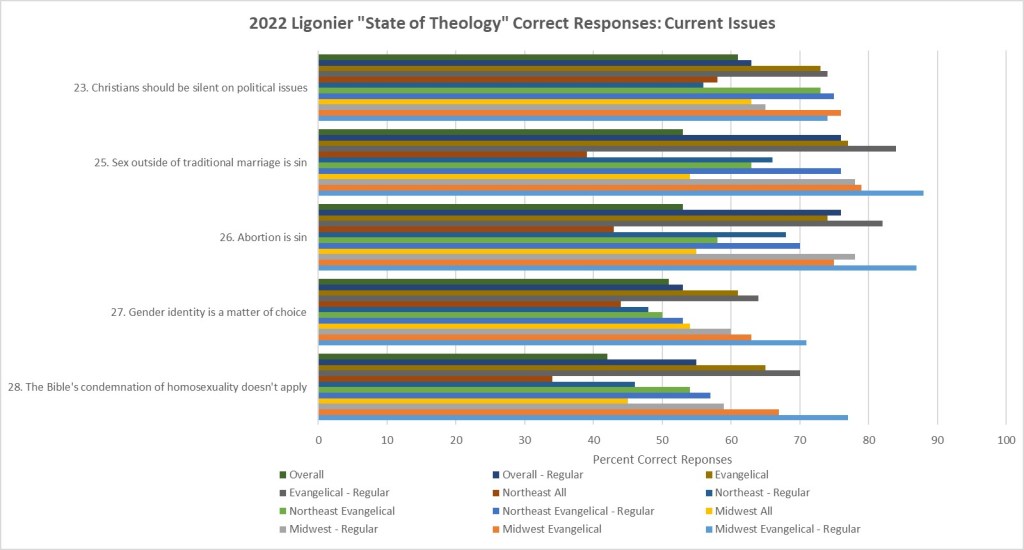
With that foundation, here are the results from the survey regarding current issues. Results are shown below:
State of Theology: Christian Societal Responsibility
23. Christians should be silent on issues of politics.
This question deals with the Christian’s responsibility regarding society, which is clearly implied in Scripture. While Scripture does not direct or imply any particular level or nature of political involvement, it is clear that Christians should be deeply concerned about the society in which they live, seeking to improve it in ways that glorify God (Jeremiah 29:7). Israelites were commanded to care for widows, orphans, and sojourners (Deuteronomy 14:29 and 24:17) as well as to relentlessly pursue justice and mercy (Exodus 23:6, Zechariah 7:9). While these commands could be considered part of the civil law, they are undergirded by the moral law that is still just as binding today as it was then. They are part of loving your neighbor as yourself (Leviticus 19:8) and not neglecting the weighty matters of justice (Matthew 23:23) as clearly taught by Jesus. Many political issues are issues of justice, so to be silent about them is to disobey these commands. Scripture is equally clear that silence in the face of injustice and oppression are just as sinful as the injustice and oppression themselves (Job 31:16-23, Isaiah 1:16, Ezekiel 22:6-12). This means it is incompatible with Scripture to say that Christians should be silent on political issues in general. Over half of respondents across all categories affirmed that silence about politics is not commanded in Scripture, ranging from 56% of regularly attending Northeasterners to 76% of Midwest evangelicals. These results are mixed, but generally positive. While there is certainly room for debate as to how much political involvement is prudent and appropriate, it would be improper to say that silence is required. However, it is equally important to stress that while individual Christians can be involved in the political process, it is not the place of churches to be officially involved in politics. We do not wage war using the weapons of the world (2 Corinthians 10:4), including politics. The Gospel is what truly transforms society, and history teaches that such transformations are often slow. Churches must focus on the Gospel, which then compels individual believers to act in ways that advance the Kingdom of God much as it compelled people like William Wilberforce to fight against slavery over two centuries ago.
State of Theology: Extramarital Sex
25. Sex outside of traditional marriage is a sin.
This question is explicitly addressed in Scripture by the Seventh Commandment as interpreted by Jesus (Matthew 7:27-32). Scripture therefore defines “traditional marriage” as the covenantal union between one man and one woman as established by God to reflect the diversity and unity of the Trinity as well as the union between Christ and the Church (Genesis 1:28, Ephesians 5:22-33, Colossians 3:18-19, 1 Peter 1:7). Throughout Scripture, sex outside of this union is prohibited (Leviticus 15 and 20, Proverbs 5-7, Mark 10:1-12, 1 Corinthians 5-6). This is further echoed by Paul with his use of the generic term “sexual immorality” as any sexual activity outside of God’s definition of marriage (Romans 13:13, 1 Corinthians 10:8, 2 Corinthians 12:21, Galatians 5:19, Ephesians 5:3, Colossians 4:3). Thus, Scripture is clear that sex outside of traditional marriage (as defined by God) is sinful. While over half of respondents across all categories except the Northeast (at 39%) affirmed this, it is concerning that results both overall (53%) and for the Midwest (54%) were also relatively low for something so clearly taught by Scripture. Only with regularly attending evangelicals nationwide and in the Midwest were results better than 80%, showing that in certain regions and denominations the sin of extramarital sex has either been denied or neglected. This is especially concerning when we consider that this question only deals with the act of sex and not with lust, which Jesus equates with adultery (Matthew 5:27-28). Had the question included lustful thoughts, pornography, and other forms of sexual immorality outside of sex itself, I fear the results would have been much more negative. Still, it is slightly encouraging to see that in our hypersexualized society, the majority in most categories did affirm the sinfulness of extramarital sex, even if it was only a slight majority.
State of Theology: Abortion
26. Abortion is a sin.
The question of abortion is not clearly addressed in any passage of Scripture but is clearly implied by Scripture overall. Since the term “abortion” does not appear in Scripture, it must be defined first. For our purposes, abortion is the termination of a pregnancy by the willful killing of the baby in the womb. Thus abortion is a premediated act and not the death of the child during an act of medical necessity to save the mother’s life. Being the killing of a baby, abortion is sinful if it falls outside of the limitations for killing in Scripture. The command against killing in Scripture rooted in the Sixth Commandment forbidding murder, which is reiterated by Jesus, proving that it is part of the moral law and thus still applicable today (Matthew 5:21, 15:19, and 19:18, Mark 7:21 and 10:19, Luke 18:20). While speaking His covenant to Noah, God says “Whoever sheds the blood of man, by man shall his blood be shed, for God made man in his own image” (Genesis 9:6). This comes just before God reiterates the cultural mandate to be fruitful and multiply (verse 7), so it refers to all mankind (men and women of all ages). This establishes that since people are made in the image of God, killing them is a grave sin apart from specific circumstances explicitly set out by God. The first of these caveats is seen in this passage: punishment for murder or other serious crimes, which must only come after a just conviction (Numbers 35:30, see also Exodus 21:12-14. Leviticus 24:17-18, Numbers 35:31). The second is the killing of enemy combatants in battle (which is allowed in certain circumstances throughout Scripture) and when the death of a perpetrator happens due to self-defense that was not premeditated (Exodus 22:2-3). Scripturally, the killing of a person outside of these caveats is murder and thus sinful.
Scripture is equally clear that a baby in the womb is a person with equal worth to any other person. The Bible explicitly states that God forms babies in the womb (Psalm 139:13-16, Isaiah 44:2-4 and 46:3, Jeremiah 1:5), God knows babies in the womb as unique people (Isaiah 49:1-5), and the baby is a person with both body and spirit in the womb (Ecclesiastes 11:5). Also, John the Baptist was indwelt by the Holy Spirit in the womb (Luke 1:15) and leaped for joy (in Elizabeth’s womb) when Jesus came near (in Mary’s womb), showing that both were full persons in the womb (Luke 1:41 and 44). Therefore, Scripture clearly teaches that a baby in the womb is not a clump of cells without a soul that can be removed amorally like a tumor, but is a living person and therefore cannot be justly killed without meeting the Biblical criteria for justly killing any other person. A baby in the womb is not an enemy combatant or the perpetrator of a serious crime, so Scripture does not allow the baby to be justly killed. Scripture further emphasizes the particular evil of killing children by describing children as a blessing (Psalm 127:3), outlawing child sacrifice as particularly abominable (Leviticus 18:22 and 20:2-5), and naming the abhorrent practice of child sacrifice as a major reason why Israel and Judah were destroyed (2 Kings 13:10 and 17:17, Psalm 106:37-38, Jeremiah 32:35, Ezekiel 16:20). Thus, we can clearly deduce from Scripture that abortion is murder and thus sinful.
Results on this question were mixed, with 87% of regularly attending Midwest evangelicals but only 43% of Northeasterners affirming the biblical teaching of abortion as sinful. Region and church attendance both had significant impact, with the Midwest performing better and the Northeast performing worse than the national average. Evangelicals and regular attenders also scored significantly better across all categories. This may suggest that Christians and churches are reflecting the views of the regions they are in regarding abortion, with some falling prey to the crafty and plausible arguments (Colossians 2:4) that use careful rhetoric to paint abortion as something other than murder of innocent children by denying the personhood of the child. Since Scripture commands us to fight against any such argument that is raised against Scripture (2 Corinthians 10:5), the church cannot tolerate such arguments and still be obedient to Scripture and to Christ. This means we need to refrain from language that dehumanizes, replacing “the unborn/preborn” and “it” with “baby/child in the womb” and “he or she”. As Joshua said to the Israelites, we must choose this day whom we will serve, the God of the Bible and Jesus Christ our Lord, or the gods of sex, convenience, prosperity, bodily autonomy, and self to which children are sacrificed in the practice of abortion (Joshua 24:15). Scripture says the blood of the innocent cries out to God, who will answer in justice and wrath against those who shed it (Genesis 4:10-11, 1 Kings 21:19, Ezekiel 22-24, Revelation 16:6 and 19:1-2)—and even if we consider the clear teaching of Scripture that all people are fallen sinners even in the womb, there is no human so innocent as a baby in the womb. We must repent of the grave evil of abortion, starting by acknowledging its inherent sinfulness.
State of Theology: Gender
27. Gender identity is a matter of choice.
Gender identity is another concept that is not explicitly addressed in Scripture but can be easily deduced from it. Scripture is clear that God made people as male and female (Genesis 1:27) which Jesus reiterates (Matthew 19:4, Mark 10:6). The distinction between male and female is in the likeness of the distinction in the Trinity (Genesis 1:26-27 and 5:1-2). This means that since Adam and Eve were made in the likeness of the Triune God, the distinction between men and women reflects the distinction between God the Father, Jesus, and the Holy Spirit. The members of the Godhead are unique and cannot become one another, which means that men and women are distinct and cannot become the other. God accentuated this distinction by creating the first man and woman separately, creating Adam from the dust and Eve from Adam (Genesis 2:7 and 21-22, 1 Corinthians 11:8), a distinction which is not mentioned for anything else in creation. Scripture is also equally clear that it is foolish and rebellious to question why God made anyone the way He did (Isaiah 29:16 and 45:9, Jeremiah 18:1-6, Romans 9:20-21), which would include gender. The Mosaic law also prohibits men from dressing (and thus presenting themselves) as women and vice versa (Deuteronomy 22:5). While we cannot and should not overlook the cultural context of this command, we similarly cannot dismiss it as obsolete for that reason. Gender-distinctive clothing certainly varies by culture, but the underlying moral law concept is that men should not present themselves as women and women should not present themselves as men. Again, this is rooted in the distinctiveness of men and women, which is itself rooted in the distinctiveness between the members of the Trinity. Jesus does not present Himself as God the Father or as the Holy Spirit, and the Father and Holy Spirit do not present themselves as Jesus or each other, so in imaging them we must present ourselves as we were created. Paul proves this by applying it to Corinth, which was culturally much closer to modern America than ancient Israel (1 Corinthians 11). Scripture therefore teaches that God assigns people the gender of either male or female in the womb which cannot be changed, so gender is not a matter of choice.
This question produces some of the worst results in this category, with only 71% of regularly attending Midwest evangelicals and a mere 44% of Northeasterners affirming Scripture’s teaching on the unchangeable and God-assigned nature of gender. This is somewhat surprising considering the overwhelming affirmation of the fact that God created male and female in question 8, which I discussed previously. This may be due to a misunderstanding of the implications of that question: we should not blur the lines God has made distinct. It could also indicate a willful rejection of the obvious implications of that question, instead caving to the significant societal pressure to accept a fluid understanding of gender. Either way, it is very disturbing. Since God created us as male and female, the church that confuses male and female is rebelling against God. In this and every other area, we must obey Scripture rather than culture.
State of Theology: Homosexuality
28. The Bible’s condemnation of homosexual behavior doesn’t apply today.
This question is different from the others in how it approaches the sinfulness of homosexuality. Instead of asking if homosexuality is a sin, the question asks if it is still a sin. Unlike the terms “abortion” and “gender”, homosexuality appears and is explicitly condemned in Scripture, being outlawed in Leviticus 18:22 and 20:13. So this question asks if that condemnation is still applicable today. If these commands in Leviticus are part of the civil or ceremonial law, the argument could be made that they no longer apply. But if they are part of the moral law, the condemnation of homosexuality is just as applicable to us today as it was to the Jews thousands of years ago. When we look at the whole of Scripture, it becomes clear that the condemnation of homosexuality is part of the moral law. In the Old Testament, it is used as an indicator of rampant wickedness in both Sodom (Genesis 19:4-9) and Gibeah (Judges 19:22-24). Paul similarly refers to homosexuality as both a sin bringing about God’s future wrath and part of God giving people over to their own destructive devices in His present wrath (Romans 1:26-27), emphatically stating that those who practice homosexuality are lawless and disobedient against God (1 Timothy 1:6-11) and will therefore not inherit the kingdom of God (1 Corinthians 6:9). Since homosexuality is condemned throughout the Old and New Testament as part of the moral law, it is clearly still condemned for believers today.
Results for this question were mixed but generally poor, with 77% of regularly attending Midwest evangelicals but only 34% of Northeasterners affirming the present sinfulness of homosexuality. Church attendance, region, and denomination all had significant impacts on these results, with regular attenders and evangelicals significantly outperforming the other categories. The Midwest also performed slightly better and the Northeast performing slightly worse than nationwide in respective categories. Less than 50% of nationwide, Northeast, and Midwest respondents answered correctly, along with only 46% of regularly attending Northeasterners. When this is combined with the fact that all categories except nationwide and Midwest regularly attending evangelicals had less than 70% of respondents answering correctly, it is clear that the church as a whole has compromised on the issue of homosexuality. The church has largely chosen to side with man rather than God on this and various other issues, which is grievous to say the least.
Key Takeaways
In every place and generation, the church is faced with the decision of siding with God or the world on various issues. Godly churches have searched the Scriptures and then applied what Scripture teaches to the specific situation, holding fast to what Scripture says over and above all earthly powers. In our day, the relationship between faith and politics, extramarital sex, abortion, gender, and homosexuality are all issues which the American church is faced with that choice. From the results of this survey, some American churches have held to what Scripture clearly teaches on these issues but many have not, instead downplaying or even embracing the sins of extramarital sex, abortion, gender confusion, and homosexuality. Jesus rebuked the churches of Pergamum and Thyatira for tolerating similar sins (Revelation 2:14-23), so the American church should expect similar rebuke if we tolerate them as well. The remedy for this is the same as the remedy for deficiencies in every other category. The American church must first repent and commit to obeying God rather than man. We also need to teach people both what Scripture clearly teaches about these issues and how to study and apply Scripture to any issue. Churches must confront these sins so they do not poison the church (1 Corinthians 5:1-7, 1 Timothy 5:20, Hebrews 12:15), boldly declaring what Scripture teaches on these issues and applying the process of church discipline that Jesus laid out (Matthew 18:15-17) to lovingly call those who practice or support these sins to repentance. Christians in churches that refuse to do this should prayerfully consider leaving those churches. While commitment to the local church is extremely important—as discussed last time—that does not preclude Christians from leaving a church that has compromised to the point of being a “synagogue of Satan” (Revelation 2:9 and 3:9).
Finally, it is important to highlight that while extramarital sex, abortion, homosexuality, and gender confusion are sinful according to Scripture, they are not the unpardonable sin of continually and finally rejecting Jesus Christ, which He calls “blasphemy against the Spirit” (Matthew 12:31-32, Luke 12:10). While Jesus rebukes the church of Pergamum for tolerating sexual sin, He also patiently and lovingly calls on them to repent (Revelation 2:16). Just as the man Paul rebukes for egregious sexual sin in 1 Corinthians 5 appears to have repented and been restored to fellowship (2 Corinthians 2:5-7), God is able to rescue and transform people from all manner of sexual sins. Because these sins are so pervasive in our culture, even the most biblical churches will contain people who have committed adultery in various ways, women who have had or are considering abortions, men who have pressured or are pressuring women to get abortions, people who are confused about their gender, and people who struggle with same-sex attraction. In calling them to repentance and helping them through these struggles, it is of utmost importance to approach them with gentleness, love, and humility, helping bear their burdens rather than adding to them (Galatians 6:1-3). The same God who forbids us from celebrating these sins also exhorts us to treat everyone with dignity and respect as people made in His image. Let those who struggle with these sins be called to repentance and helped to obey Scripture in such a loving, patient, kind, compassionate, yet uncompromising way that the love they experience in the church is far greater, deeper, and more substantial than any acceptance they would receive outside the church. After all, the true mark of a Christian is supernaturally empowered love for one another (John 13:35, 1 John 4:7-8).
Conclusion
All in all, while the results of the 2022 Ligonier State of Theology survey were rather dismal in this and other categories, they reveal that the challenges faced by the church in America are similar to the challenges faced by the Church throughout the centuries—and these challenges all have the same remedy. All believes need to understand Scripture, who God is, who we are, the path to salvation, the importance of the church, and how to apply what Scripture teaches to every aspect of life. So I will end this series with the words of Jesus. After pronouncing judgment on a persistently unrepentant woman he referred to as “Jezebel” who was leading the church of Thyatira into sexual sin, He gives both hope for the church to cling to and a warning for the church to heed:
But to the rest of you in Thyatira, who do not hold this teaching, who have not learned what some call the deep things of Satan, to you I say, I do not lay on you any other burden. Only hold fast what you have until I come. The one who conquers and who keeps my works until the end, to him I will give authority over the nations, and he will rule them with a rod of iron, as when earthen pots are broken in pieces, even as I myself have received authority from my Father. And I will give him the morning star. He who has an ear, let him hear what the Spirit says to the churches.
-Revelation 2:24-29, ESV
[1] John Calvin, Institutes of the Christian Religion: Translated from the First French Edition of 1541 by Robert White, Edinburgh, UK: Banner of Truth Trust: 2014: 179-180, 768-769.
[2] John Calvin, Institutes of the Christian Religion: Translated from the First French Edition of 1541 by Robert White, Edinburgh, UK: Banner of Truth Trust: 2014: 179-181, 453-460, 768-769.
[3] John Calvin, Institutes of the Christian Religion: Translated from the First French Edition of 1541 by Robert White, Edinburgh, UK: Banner of Truth Trust: 2014: 768-769.
This is a series addressing the problem of theological illiteracy using the results of the 2022 State of Theology survey by Ligonier Ministries, available here. For an overview of the results and methodology used, see the first post here.
Therefore, brothers, since we have confidence to enter the holy places by the blood of Jesus, by the new and living way that he opened for us through the curtain, that is, through his flesh, and since we have a great priest over the house of God, let us draw near with a true heart in full assurance of faith, with our hearts sprinkled clean from an evil conscience and our bodies washed with pure water. Let us hold fast the confession of our hope without wavering, for he who promised is faithful. And let us consider how to stir up one another to love and good works, not neglecting to meet together, as is the habit of some, but encouraging one another, and all the more as you see the Day drawing near.
-Hebrews 10:19-25, ESV
As important as the doctrines of salvation are to the Christian faith, they are just the beginning of the precious theological concepts the Christian should be constantly immersed in. Jesus Christ did not merely save individuals, but He saved individuals to be part of a His body, family, army, and Bride: the Church. Therefore, a proper understanding of the Church is vital to Christianity. Only a few questions from the 2022 Ligonier State of Theology survey covered the topic of the church, which revealed some crucial deficiencies in the American understanding of what Jesus Christ holds most precious. To discuss these, we must introduce a few key theological concepts about the church:
Universal Church: All Christians everywhere and across time are part of the universal Church. This includes Old Testament saints who trusted in the future work of Christ (Hebrews 11) as well as all who have trusted in Christ in the past, trust in Him now, and will trust in Him in the future. Men, women, children, people of all nations, ages, and backgrounds make up the universal Church. Scripture teaches that belonging to Christ as part of the universal Church is the most important distinctive for any person, far superseding any human categories.[1] (Psalm 22:22, Ephesians 2:14=19, 2 Timothy 2:19)
Local Church: The Christian life is to be lived within the context of the local church, which is the body of believers who gather together in a particular place. The local church is differentiated from parachurch ministries by the preaching of the Word (2 Timothy 4:1-2), right administration of the sacraments (sometimes called ordinances) of baptism (Matthew 28:19-20) and communion (Matthew 26:26-28, 1 Corinthians 11:20-28), and the practice of church discipline (Matthew 18:15-20).[2] (Acts 20:28, 1 Timothy 3:15)
Corporate Worship: The local church is to gather corporately weekly on Sunday for the preaching of the Word, administration of the sacraments of baptism and communion, worship of God in song, confession of sin, reading of Scripture, and biblical instruction. While all of the Christian life should be lived in worship to God (Romans 12:1), God is particularly honored and has chosen to be particularly present in corporate worship, equipping the saints for ministry in corporate worship in ways He does not work in us individually.[3] (Acts 2:42-47 and 20:7)
Proper Worship: While there is some debate between churches as to the specifics of how God is to be worshipped, all can agree that God must be worshipped in accordance with Scripture. God must be worshipped in spirit and truth (John 4:24). To worship in spirit means that the only worship that can be acceptable to God must come from those who have been regenerated and indwelt by the Holy Spirit (i.e., those who trust in Christ). To worship in truth means—at the very least—that only worship coming from a true knowledge of who God is can be acceptable to God. As previously discussed, to imagine God in any way that deviates from the way He is portrayed in Scripture is to worship a false god. This means worship that portrays God in any way contrary to Scripture is false worship—i.e., idolatry that is abhorrent to God.[4] (Exodus 34:14, Deuteronomy 12, Psalm 145:18, Mark 7:6-7, 1 Corinthians 14:26-40, Philippians 3:3, Hebrews 12:28)
The Ligonier 2022 State of Theology survey questions on the church showed the worst results of all the categories I looked at. Sadly, this is not all that surprising when we contrast the corporate nature of the life of the church in Scripture with our individualistic society. Only two questions clearly fit into the category of the church, with an additional question fitting better in that category than any other (which I will explain later). Results are shown below:
State of Theology: Proper Worship
One question did not fit cleanly into any category: worship from other religions. Since this question deals with how God is worshipped, I thought it fit best within the category of the church.
3. God accepts the worship of all religions, including Christianity, Judaism, and Islam.
This question yielded the worst results of any question. Only 42% of nationwide and regularly attending evangelicals and a mere 18% of Northeasterners affirmed the necessity of proper worship. Scripture is clear that God cares deeply about how He is worshipped. As early as Cain and Abel, God established correct ways to worship Him and did not honor incorrect worship (Genesis 4:3-7). This is most vividly seen when Israel made the golden calf to worship God as they saw other nations worship their gods (Exodus 34) and when Nadab and Abihu improperly worshipped God by offering “strange fire” (Leviticus 10). God brought a plague on Israel and killed Nadab and Abihu for worshipping Him improperly. The call to worship God properly and the condemnation of improper worship are seen throughout the Old Testament (e.g., Jeremiah 14:12, Amos 5:22, Malachi 1). There may have been some confusion over the term “accepts” in this question, since there are times in Scripture where God seems to accept the attempts of pagans to worship Him. For example, when the Philistines capture the Ark of the Covenant, resulting in God sending a plague among them, they respond with an offering of gold as they send the Ark back to Israel. God seems to accept this attempt at worship and removes the plague (1 Samuel 6:3-12), which could be seen as a precedent for God accepting the improper worship of people who are ignorant of the proper ways to worship Him. However, Scripture does not explicitly say that God accepted the offering. When I discussed the immutability of God, I stated that God only ever does what He has always intended to do. Regardless of the Philistines’ intentions or actions, God chose to glorify Himself among them by showing His power over both them and their idols, which He accomplished by removing the plague once they returned symbol of His presence to His people. Conversely, God chose to glorify Himself by killing seventy Israelites for handling the Ark improperly once it was returned, since they had the Law on how to handle the Ark and were therefore without excuse (1 Samuel 6:19-22). Thus, it cannot be said that God accepted improper worship in the Old Testament but only that He did not always punish people for it.
The most we can say is that in the time before Christ, God overlooked the ignorance of such attempts to worship Him, but that should not be taken as acceptance of that worship. Regardless, Scripture is clear that since Christ has come, God no longer overlooks improper worship, instead calling on all people everywhere to repent of that improper worship (Acts 17:29-31). Since anything that does not come from faith in Christ (including worship) is sinful (Romans 14:23), the worship offered by those practicing other religions is abhorrent to God. And since I previously established that any understanding of God that does not align with Scripture is a false god concocted by human imagination, any worship of such a god is idolatry, which is constantly condemned in Scripture. Religions such as non-Messianic Judaism and Islam deny the Trinity and therefore worship false gods, no matter how genuine and devout they may be or how closely those gods may resemble the God of the Bible. It is only God’s amazing kindness that keeps Him from striking them dead for improper worship like He struck Nadab and Abihu—or striking us dead every time we fail to worship God properly. That kindness is supposed to lead us to repentance (Romans 2:4), so the American church must repent. God takes His worship seriously and we should too, worshipping Him in the only way we can properly worship Him: in spirit and truth (John 4:23-24).
State of Theology: Corporate Worship
22. Worshiping alone or with one’s family is a valid replacement for regularly attending church.
This question is rooted in the clear teaching of Scripture on the importance of the local church regularly and physically gathering together. Scripture is clear that Christians must not neglect the corporate gathering of the local church (Hebrews 10:25). The terms “neglecting” and “habit” imply that this does not mean that it is never acceptable to miss church but that missing church should be the rare exception and not the norm. Less than half of respondents across all categories affirmed the importance of the corporate gathering of the saints, with only 49% of Midwestern and Northeastern regularly attending evangelicals, 46% of regularly attending evangelicals overall, and 21% of Northeasterners affirming what Scripture clearly teaches in this area. This is disheartening but unsurprising, considering the effect of the pandemic on the church as a whole. For the first time in anyone’s memory, the American church was faced with a widespread challenge to what Hebrews 10:25 means. Some churches closed entirely (at least temporarily) while others continued to meet virtually. While many churches have resumed in-person meeting, many believers enjoy the convenience of virtually attending live-streamed or pre-recorded services from the comfort of their homes and thus consider that an acceptable substitute for the physical gathering of the saints.
But this did not start with the pandemic. Long before 2020, the American church like the American culture grew individualistic, emphasizing personal faith and experiences over the corporate nature of the church. The mantra “just me and my Bible” was popular long before “social distancing” became a household term. To justify this, some take Matthew 18:20 out of its context of church discipline to say that it makes any gathering of the saints equal to Sunday worship. The pandemic therefore merely gave an excuse for people to neglect the corporate gathering of the local church in favor of merely family gatherings. Family worship is extremely important (and often undervalued in the church), but it should never be considered a substitute for corporate worship. The church since Pentecost has worshipped both publicly and privately, so that must be the expectation. While live-streamed services are a blessing for those who are sick, traveling, or otherwise unable to attend church physically every now and then, they are no substitute for the blessing of meeting together with the saints. It is possible to sing praises alone or along with a live stream, but that can never compare to singing with the saints in the same physical place. At the very least, the sacraments are greatly diminished if they are attempted alone—and I would argue that they cannot be adequately and faithfully practiced outside of physical corporate worship. In the Reformed understanding, these are means of grace—practices that God chooses to use to impart grace to His people. Some means of grace can and should be utilized privately, such as prayer, Scripture reading, and meditating on the truths of Scripture.[5] But no matter how much you partake of these means, neglecting the means of grace that can only come through physical participation in the corporate worship of the local church is to have a woefully inadequate and unbalanced diet of grace. God has also ordained that everyone in the church needs everyone else in the church. The local church is not a group of individuals but a family, a body, and an army. Just as a family relationship is negatively impacted by prolonged separation, a well-functioning body needs all of its parts to be connected, and an uncoordinated army cannot succeed, so the local church cannot flourish (or even survive) the prolonged absence of its members. God takes the corporate, physical gathering of the local church very seriously, so we should too. Christians all across America must therefore reject the individualism of our culture and commit to participate in the regular, physical gathering of the saints.
State of Theology: The Importance of the Local Church
24. Every Christian has an obligation to join a local church.
This question showed the strongest results in this category, though only 67% of regularly attending Northeastern evangelicals and a mere 34% of Midwesterners affirmed the Christian’s obligation to the local church. This isn’t overly surprising considering the response to question 22, but it is equally concerning. What was surprising is that the Northeast performed better than the Midwest on this question, which may point to a local cultural emphasis on church membership in the Northeast that is lacking in the Midwest. Still, the overall results showed that many Christians feel no obligation to join a local church. This reflects a general view of church as just a place you go (physically or virtually) on Sunday morning, to which people have no real commitment. Scripture teaches the opposite, referring to the church as a family (2 Corinthians 6:18, Galatians 6:10, Ephesians 2:19), army (Ephesians 6:10-20, Philippians 2:25, 2 Timothy 2:1-4, Philemon 2), and body (Ephesians 1:22-23 and 4:15-16, Colossians 2:19)—all of which imply long-term commitment. Our culture in recent generations balks at such commitment. Our consumer mentality has replaced long careers at the same organization with job hopping, committed marriage to no-strings-attached hookups and no-fault divorces, and long-term investments with get-rich-quick investing strategies. We buy now and pay later, going into crippling debt because we are impatient, unwilling to commit to put in the effort for the long-term, especially when times get tough.
It should come as no surprise then that we view the church in the same way. To many Christians, the church is providing them a service—and they evaluate it as such. We “church shop”, comparing the entertainment value of the music, the way the sermon makes us feel, the quality of the coffee bar, the toy and snack selection of the nursery, whether the service gets done in time for the game, and many other selfish criteria. When the church doesn’t serve us as we desire, we are quick to leave it and find a church that will. This bears zero resemblance to what Scripture teaches about the church being a family and an army, both being organizations where participation is not optional. There is no such thing as family hopping, and switching armies is called treason. A lack of commitment to the church needs to become equally absurd to American Christians. The default should be commitment to a single local church for life unless circumstances like moving to a different area, changing theological convictions, persistent systemic sin within the leadership of the church, being sent out as a missionary, leaving on a church plant, or generally being called by God to ministry in some other way force you to leave a church. My present life situation requires me to move frequently, so I cannot commit to a church for as long as I would like. Nevertheless, at each location I emphasize quickly finding a faithful local church and committing to that church until God moves me somewhere else. One day, this season will be over, enabling me to commit to a local church for the rest of my life unless God moves me somewhere else. The American church needs to restore the need for commitment to the local church.
Key Takeaways
Since the survey revealed that the American church has an improper view of God, an overly exalted view of man, and a cheapened view of sin that cheapens the Gospel, it should come as little surprise in light of our individualistic society that results on the doctrines of the church were dismal. Satan must be reveling in how effectively he has been able to tempt so many who call upon the name of Christ in America to so comprehensively cheapen and largely reject the local church. He knows that lone Christians apart from the local church are largely ineffective, so he is happy to oblige thoughts of self-sufficiency and individualistic false worship that keep people from the church. Conversely, God views the church very highly. Since Christ purchased the Church with His priceless blood to be His Bride (2 Corinthians 11:2, Ephesians 5:32, Revelation 19:7-9 and 21:1-11), God promises to destroy whoever destroys the Church (1 Corinthians 3:17). Therefore, we should be very apprehensive to leave that which Jesus so loves, especially for any of the aforementioned reasons that can only be describe as petty and ridiculous.
Satan is equally happy to facilitate selfishness and its resulting conflict within the local church that greatly hinders the church’s effectiveness (Romans 16:17, 1 Corinthians 1:10-3:23 and 11:18, 3 John 9, Jude 19). The American church needs to grieve for and repent of these grave sins. Every American Christian should commit to the local church, regularly (weekly) attend the Sunday gathering of the local church (in person, not virtually) and seek to serve the church rather than consume from the church. We also need to ensure we are worshipping God rightly and not offering false or ignorant worship that is abhorrent to Him. God will not long endure churches that tolerate false worship (Revelation 2:20-23), so if we don’t repent of our neglect of the church and distortion of worship, we risk God removing the American church entirely like Ephesus (Revelation 2:4-5), Sardis (Revelation 3:1-3), and Laodicea (Revelation 3:15-16). Only in the church does God promise spiritual victory (Matthew 16:18), so we are foolish to think we can have any lasting success in the Christian life or advancement of the Kingdom of God apart from the context of the church. We need to love what Jesus loves, and Jesus loves the Church! Therefore we must heed the warning of Revelation, for if only the Church as the Bride of Christ will feast with Him in heaven, so we must be part of that Bride to be invited to that feast. Final blessing is only found in the church, so let us be found there as well.
Then I heard what seemed to be the voice of a great multitude, like the roar of many waters and like the sound of mighty peals of thunder, crying out, “Hallelujah! For the Lord our God the Almighty reigns. Let us rejoice and exult and give him the glory, for the marriage of the Lamb has come, and his Bride has made herself ready; it was granted her to clothe herself with fine linen, bright and pure”—for the fine linen is the righteous deeds of the saints….And I saw the holy city, new Jerusalem, coming down out of heaven from God, prepared as a bride adorned for her husband. And I heard a loud voice from the throne saying, “Behold, the dwelling place of God is with man. He will dwell with them, and they will be his people, and God himself will be with them as their God. He will wipe away every tear from their eyes, and death shall be no more, neither shall there be mourning, nor crying, nor pain anymore, for the former things have passed away.” And he who was seated on the throne said, “Behold, I am making all things new.” Also he said, “Write this down, for these words are trustworthy and true.” And he said to me, “It is done! I am the Alpha and the Omega, the beginning and the end. To the thirsty I will give from the spring of the water of life without payment. The one who conquers will have this heritage, and I will be his God and he will be my son. But as for the cowardly, the faithless, the detestable, as for murderers, the sexually immoral, sorcerers, idolaters, and all liars, their portion will be in the lake that burns with fire and sulfur, which is the second death.”
-Revelation 19:6-8, 21:2-8, ESV
[1] Wayne Grudem, Systematic Theology: An Introduction to Biblical Doctrine, Grand Rapids, MI: Zondervan: 1994: 853, 855; Louis Berkhof, Systematic Theology, Edinburgh, UK: Banner of Truth Trust: 2021: 587, 589.
[2] Wayne Grudem, Systematic Theology: An Introduction to Biblical Doctrine, Grand Rapids, MI: Zondervan: 1994: 864-866; Louis Berkhof, Systematic Theology, Edinburgh, UK: Banner of Truth Trust: 2021: 601-602; John Calvin, Institutes of the Christian Religion: Translated from the First French Edition of 1541 by Robert White, Edinburgh, UK: Banner of Truth Trust: 2014: 264, 270.
[3] Wayne Grudem, Systematic Theology: An Introduction to Biblical Doctrine, Grand Rapids, MI: Zondervan: 1994: 950-952; Louis Berkhof, Systematic Theology, Edinburgh, UK: Banner of Truth Trust: 2021: 630-632.
[4] Wayne Grudem, Systematic Theology: An Introduction to Biblical Doctrine, Grand Rapids, MI: Zondervan: 1994: 1003-1013.
[5] Wayne Grudem, Systematic Theology: An Introduction to Biblical Doctrine, Grand Rapids, MI: Zondervan: 1994: 950-952; Louis Berkhof, Systematic Theology, Edinburgh, UK: Banner of Truth Trust: 2021: 630-632.
This is a series addressing the problem of theological illiteracy using the results of the 2022 State of Theology survey by Ligonier Ministries, available here. For an overview of the results and methodology used, see the first post here.
And we know that for those who love God all things work together for good, for those who are called according to his purpose. For those whom he foreknew he also predestined to be conformed to the image of his Son, in order that he might be the firstborn among many brothers. And those whom he predestined he also called, and those whom he called he also justified, and those whom he justified he also glorified.
-Romans 8:28-30, ESV
For I delivered to you as of first importance what I also received: that Christ died for our sins in accordance with the Scriptures, that he was buried, that he was raised on the third day in accordance with the Scriptures,
-1 Corinthians 15:3-4, ESV
Previously, we laid a biblical foundation for the nature of God and our own fallen, sinful nature, noting how far the 2022 Ligonier State of Theology survey indicates the American church has fallen short on these doctrines. Now, we need to look at the doctrines of salvation. While often reduced to the event of placing faith in Jesus, Scripture teaches that salvation is actually a process that began in eternity past and proceeds past the end of time. It’s several steps are known as the ordo salutis, or order of salvation. Just as the short space of a blog post is insufficient to do justice to the doctrines of God, man, and sin, it is equally insufficient to do justice to salvation. John Murray’s Redemption—Accomplished and Applied covers the topic well. Nevertheless, I do need to introduce the topics pertinent to the survey:
Election: Scripture clearly teaches that God chose those He would save before creation, which is known as election. There is significant debate between genuine Christians on the nature of election, whether God chooses those He will save because He knows they will choose Him or if God chose those He would save then enabled them to choose Him. I subscribe to the latter, but many genuine Christians believe the former.[1] (Psalm 65:4, Acts 13:48, Ephesians 1:4-6 and 12)
Penal Substitutionary Atonement: Sinful man cannot be righteous unless the perfect righteousness of Christ is counted as the believer’s and the believer’s sin counted as Christ’s and thus atoned for by His blood. This is penal substitutionary atonement, in which God counts our sin as Christ’s so that He could pay the penalty for that sin, and also counts Christ’s perfect record of righteousness as ours. Thus Christ accomplished salvation for all believers apart from any works or merit we could possibly provide, which was necessary since only the blood of Christ can atone for sin.[2] (Luke 24:25-27 and 45-46, Romans 3:26, Hebrews 9:25-28)
Justification is the instantaneous act of God as part of His work of salvation in which He considers the believer’s sin to be Christ’s (and thus forgiven because of Christ’s substitutionary atonement) and Christ’s perfect record of obedience as the believer’s, resulting in God legally declaring the believer to be righteous in His sight independent of any work or merit on the believer’s part. This exchange is known as double imputation, in which our sin is imputed to Christ and considered His for the purpose or redemption and His perfect righteousness is imputed to us and considered ours. This is the basis of justification.[3] (Romans 8:28-30, 2 Corinthians 5:21)
Regeneration: Since we are all dead in sin, salvation requires us to be made alive spiritually. Regeneration is the secret work of God in which He gives us new spiritual life. It is the actual act of being born again. Only those who are spiritually alive can trust in Christ, so regeneration must come before conversion.[4] (Ezekiel 36:26-27, John 3:3-8, Ephesians 2:5)
Faith: More than mere intellectual ascent, faith places trust in the promise of another such that if the object of faith fails, the one with faith will suffer harm. In salvation, faith means trusting in Jesus Christ alone to deliver on His promises to save us from sin, keep us, sanctify us, and ultimately glorify us. It is complete reliance upon God not our own works or merit, so it is the vehicle through which God has chosen to bring salvation to us. True faith compels action, so it results in good works. Faith is the only proper motivation behind everything a Christian does, since anything not motivated by faith is sin.[5] (Romans 1:16-17 and 14:23, Ephesians 2:8-9, Hebrews 11:1 and 6, James 2:14-26)
Repentance: Scripture is clear that faith is not genuine unless it is inseparably joined with repentance, which is the knowledge of sin, the approval of what Scripture teaches about sin, and—most importantly—a sincere commitment to turn from sin and obey God. Repentance is both the initial act of turning from sin to follow Christ and the continual act of turning from sin in our daily lives. Repentance is not merely sorrowful over the consequences of sin, but is genuine sorrow for sin itself and the fact that it offends God.[6] (Psalm 51:17, Luke 12:3, Acts 2:37-41 and 20:21, 2 Corinthians 7:9-11, Hebrews 6:1)
Final Judgment: While God judges people at various times and in various ways, Scripture is clear that at some point in the future, Jesus Christ will judge everyone finally and completely. Since God is perfectly righteous and just—and we are all sinners—He will pronounce the punishment of His eternal wrath on all from whom He has not removed that wrath by His atoning work.[7] (Matthew 25:31-46, 2 Timothy 4:1, Revelation 20:11-15)
Hell: For believers, the execution of God’s judgment took place on the cross, when all of God’s wrath for their sin fell upon Jesus (see penal substitutionary atonement above). But for unbelievers, the execution of that judgment will be hell, which is the place of eternal and conscious punishment for the wicked. Scripture describes hell as a literal rather than metaphorical place despite the fact that certain language used to describe hell in Scripture is certainly figurative.[8] (Matthew 25:41, Revelation 14:9-11)
Since the doctrine of salvation is so rich and includes both the work of God from eternity past to eternity future and the response of man in faith and repentance, it should be no surprise that this was an area of emphasis on the State of Theology survey, with 9 questions gauging people’s understanding of it. Correct responses to these questions are shown below:
State of Theology: Election
19. God chose the people he would save before the creation of the world.
Scripture is clear that God chose who would be saved before creation (Matthew 25:34, Romans 8:29, Ephesians 1:4) even if there is an honest debate among Christians as to how God chose us. Did God look into the future, see who would choose Him, and preemptively choose them; or did He choose us in eternity past and then cause us to choose Him? I subscribe to the latter, but this question does not deal with this controversy, instead sticking with what is clearly taught in Scripture and has thus been agreed upon by the Church for centuries. But because of this controversy, it is unsurprising—albeit disappointing—that less than half of respondents across all categories affirmed this doctrine. Only 47% of Midwesterners who regularly attend church and a mere 27% of Northeasterners affirmed the doctrine of election. In all categories, the results of all denominations together were slightly better than the results for evangelicals, regardless of church attendance. I believe this points to a gross oversimplification of salvation in the understanding of many, especially among evangelicals. American evangelicalism often reduce salvation to “praying the prayer” to get “fire insurance” to the detriment of teaching on all that God does to accomplish and apply salvation—to say nothing of how that limited view distorts the very meaning of faith (which we will discuss later). I personally was not exposed to the ordo salutis until well into adulthood despite attending church my entire life, so this is definitely an area where growth is required for the American church in general and evangelical churches in particular.
State of Theology: Justification and Atonement
Two questions dealt with the sufficiency of Christ’s atonement and how God applies that to us in justification.
14. God counts a person as righteous not because of one’s works but only because of one’s faith in Jesus Christ.
34. Jesus Christ’s death on the cross is the only sacrifice that could remove the penalty of my sin.
Question 14 is the definition of justification, which is clearly taught in Scripture (Ephesians 2:8-9). With the exception of Northeasterners at 49%, more than half of respondents across all categories affirmed this doctrine. Regular attenders and evangelicals scored better than 70% across regions, which shows a generally healthy belief in this doctrine, though the lack of an overwhelming majority affirming the doctrine indicates the need to further emphasize the clear teaching of Scripture in this area. It is possible that the oversimplification of salvation (and its corresponding oversimplification of faith) in the church in general and among evangelicals in particular could have caused some inflation of these results, but they are still generally positive.
Question 34 speaks to the sufficiency of Christ’s atonement, which is similarly clear in Scripture. Results were generally positive here as well, with a majority across all categories—and over 80% of regular attenders and evangelicals—affirming this doctrine. However, when we consider these results alongside the downplaying of sin that other questions revealed, I cannot help but wonder if these results are inflated. The American church has devalued sin and therefore devalued the Gospel. If sin is no big deal, the atonement of Christ is no big deal either. If people truly grasped the seriousness of their sin, we would likely see more people genuinely trying to earn salvation and therefore answering both of these questions incorrectly. So while the results are still overwhelmingly positive, they may hide a general misunderstanding of what the atonement of Christ and salvation by faith actually mean.
State of Theology: Regeneration
10. The Holy Spirit gives a spiritual new birth or new life before a person has faith in Jesus Christ.
This question is about regeneration, gauging people’s knowledge of what it actually means to be born again. Scripture is clear that we are spiritually dead (Ephesians 2:1-3) and cannot even comprehend the Gospel—much less believe it—until the Holy Spirit gives us the new spiritual birth of regeneration (John 3:3-8, Romans 8:1-11, Titus 3:5) to which we respond by faith and repentance. This means that regeneration must come before a person places faith in Jesus Christ, which is the point of conversion. Regeneration may immediately precede conversion such that the two are nearly simultaneous, but regeneration still must come first. Results on this question were varied, with only 66% of regular attenders and 47% of Northeasterners affirming what Scripture teaches about regeneration preceding conversion. Surprisingly, regular attenders overall scored higher than evangelical regular attenders both overall (at 66% vs. 59%) and in the Midwest (63% vs. 50%), and Midwest regular attending evangelicals scored slightly lower than Midwest evangelicals overall (51% vs. 50%). While some of these numbers are too close to draw definite conclusions, I believe this points to a misunderstanding of the process of salvation among American Christians overall and evangelicals in particular. That understanding of salvation is from a human perspective, in which someone prays to receive Christ and at that point is born again, which would put faith before regeneration. Having grown up evangelical, I certainly had such a view. To me, salvation was something that Jesus did through His death and resurrection to which I responded by trusting in Him and then received the indwelling and work of the Holy Spirit. It was not until joining a reformed church in my late twenties that I learned about the ordo salutis and how much the process of salvation entails. I believe this misunderstanding can explain why evangelicals performed worse on this question and why regular church attendance for evangelicals had no or a slightly negative effect. The church in general and the evangelical church in particular needs to provide a more robust education on the entire process of salvation to correct this misunderstanding.
State of Theology: Faith
Three questions dealt with the response of the believer in faith to the God’s work of salvation:
31. Religious belief is a matter of personal opinion; it is not about objective truth.
33. It is very important for me personally to encourage non-Christians to trust Jesus Christ as their savior.
35. Only those who trust in Jesus Christ alone as their Savior receive God’s free gift of eternal salvation.
Question 31 dealt with the exclusivity of faith in Christ as the means of salvation by stating our pluralistic society’s common belief that there are many ways to God. Sadly, the results showed that many Christians agree with society on this point, with only 62% of regularly attending Midwestern evangelicals and a mere 24% of Northeasterners affirming the exclusivity of the Gospel. Other than regularly attending Midwesterners (at 51%), only evangelicals scored higher than 50% on this question, pointing to the pervasiveness of the view that Jesus is not the only way to salvation. Scripture clearly teaches the opposite: salvation can be found in none other than Christ (Acts 4:12), so any alternative gospel is accursed along with any who espouse it (Galatians 1:8-9). By that definition, there are many individuals and churches who are accursed, so the American church needs to double down on the exclusivity of the Gospel.
The exclusivity of the Gospel means that everyone who does not trust in Christ will eternally perish (question 35) which necessarily leads to the need to evangelize (question 33). Considering the weak performance on question 31, it is surprising that results for these questions were relatively strong. With the exception of Northeasterners (at 49% for question 35 and 47% for question 33) all categories showed well over 50% of respondents affirming that salvation only comes through faith in Christ and its necessary implication that believers need to encourage unbelieves to trust in Christ. While these results are positive, they are still concerning—or puzzling at the very least—when combined with the general denial of the exclusivity of the Gospel that resulted from question 31. If religious belief is a matter of preference due to a lack of objective truth, we cannot claim that faith in Christ is the only means of salvation, but the combined results of these questions suggest that many Christians believe that there is no objective truth and that their personal truth is that the only way to God is through Jesus. This cognitive dissonance must be addressed through an emphasis on the true and exclusive Gospel against religious pluralism.
State of Theology: Final Judgment and Hell
While not often considered as a part of salvation, final judgment is a crucial aspect of it. All salvation is from some terrible fate, so it stands to reason that if the salvation found in Christ is of utmost importance, it must be salvation from the worst fate possible—the wrath of God. A proper understanding of final judgment provides the required background and urgency for the Gospel, so two questions deal with it:
20. Hell is a real place where certain people will be punished forever.
21. There will be a time when Jesus Christ returns to judge all the people who have lived.
Question 20 deals with the existence of hell as a literal place where certain people will go. A bit surprisingly, at least half of respondents affirmed the existence of a literal hell across all categories, with over half of the categories showing scores of at least 80%. Some churches teach and many Christians believe that hell is figurative, though these results suggest that most Christians have not bought into that teaching.
Question 21 speaks to the final judgment of Jesus Christ, which displayed even more positive results, with at least 80% of respondents in nine of twelve categories affirming that Jesus will come to judge the living and the dead. Like the overwhelming affirmation of the Trinity observed previously, some of this is likely due to the its pervasiveness in the various creeds, such as the Apostles’ Creed. However, since the final judgment of Christ is not as pervasive as the doctrine of the Trinity in church liturgy in general, much of the positive response to this question cannot be attributed to parroting a doctrine without understanding it. Considering the general de-emphasis of the justice and wrath of God in many churches, such sweeping affirmation of both hell and the final judgment was a pleasant surprise. Still, the fact that some groups answered poorly on questions that are so clearly taught in Scripture underscores the need for churches to commit to teaching a balanced theology that includes hell and the final judgment. The questions also didn’t address who will be sentenced to hell and what the judgment criteria would be. If the results for questions on man and sin are any indications, I believe they would paint a much less rosy picture of the state of theology regarding hell and judgment.
Key Takeaways
While results for questions on salvation were generally positive, several gaps in people’s theological understanding were revealed that must be addressed. Many Christians do not understand the process of salvation and God’s predominant role in it. We need to teach a God-centric rather than man-centric view of salvation, ensuring every believe understands the entire process starting with election in eternity past. All Christians need to understand the importance of the full work of Christ on their behalf, not just His atoning death but also His record of perfect obedience throughout His life that is just as vital to salvation. That was something I didn’t understand until my late twenties—and I’m sure I’m not alone. In addition to a robust understanding of justification, Christians also need to grasp how repentance is just as important in their response to God calling them to salvation as faith. Though the Ligonier questions did not cover it, the topic of sanctification also needs to be thoroughly taught. Many Christians see salvation as completed at conversion, but progressive sanctification that occurs throughout a Christian’s life is just as much a part of salvation as conversion. Finally, we need to ensure our view of salvation includes an understanding that we will all be judged by Christ and all who have not placed their trust in Him will be sentenced to hell for eternity. To neglect this is to neglect and cheapen the Gospel itself. So we must heed the warning of Hebrews to not neglect our incredible salvation:
Therefore we must pay much closer attention to what we have heard, lest we drift away from it. For since the message declared by angels proved to be reliable, and every transgression or disobedience received a just retribution, how shall we escape if we neglect such a great salvation? It was declared at first by the Lord, and it was attested to us by those who heard
-Hebrews 2:1-3, ESV
[1] Wayne Grudem, Systematic Theology: An Introduction to Biblical Doctrine, Grand Rapids, MI: Zondervan: 1994: 669-679; Louis Berkhof, Systematic Theology, Edinburgh, UK: Banner of Truth Trust: 2021: 99-108.
[2] Wayne Grudem, Systematic Theology: An Introduction to Biblical Doctrine, Grand Rapids, MI: Zondervan: 1994: 569; 571; Louis Berkhof, Systematic Theology, Edinburgh, UK: Banner of Truth Trust: 2021: 387-389; John Murray, Redemption—Accomplished and Applied, Edinburgh, UK: Banner of Truth Trust: 1961: Section 1, Chapter 2.
[3] Wayne Grudem, Systematic Theology: An Introduction to Biblical Doctrine, Grand Rapids, MI: Zondervan: 1994: 723-725; Louis Berkhof, Systematic Theology, Edinburgh, UK: Banner of Truth Trust: 2021: 533; John Murray, Redemption—Accomplished and Applied, Edinburgh, UK: Banner of Truth Trust: 1961: Section 1, Chapter 5.
[4] Wayne Grudem, Systematic Theology: An Introduction to Biblical Doctrine, Grand Rapids, MI: Zondervan: 1994: 699-700; Louis Berkhof, Systematic Theology, Edinburgh, UK: Banner of Truth Trust: 2021: 485; John Murray, Redemption—Accomplished and Applied, Edinburgh, UK: Banner of Truth Trust: 1961: Section 2, Chapter 3.
[6]Wayne Grudem, Systematic Theology: An Introduction to Biblical Doctrine, Grand Rapids, MI: Zondervan: 1994: 713; Louis Berkhof, Systematic Theology, Edinburgh, UK: Banner of Truth Trust: 2021: 503-504; John Calvin, Institutes of the Christian Religion: Translated from the First French Edition of 1541 by Robert White, Edinburgh, UK: Banner of Truth Trust: 2014: 295; John Murray, Redemption—Accomplished and Applied, Edinburgh, UK: Banner of Truth Trust: 1961: Section 2, Chapter 4.
[7] Wayne Grudem, Systematic Theology: An Introduction to Biblical Doctrine, Grand Rapids, MI: Zondervan: 1994: 1140-1147; Louis Berkhof, Systematic Theology, Edinburgh, UK: Banner of Truth Trust: 2021: 763-769.
[8] Wayne Grudem, Systematic Theology: An Introduction to Biblical Doctrine, Grand Rapids, MI: Zondervan: 1994: 1149-1153; Louis Berkhof, Systematic Theology, Edinburgh, UK: Banner of Truth Trust: 2021: 771-772.
This is a series addressing the problem of theological illiteracy using the results of the 2022 State of Theology survey by Ligonier Ministries, available here. For an overview of the results and methodology used, see the first post here.
So God created man in his own image, in the image of God he created him; male and female he created them. And God blessed them. And God said to them, “Be fruitful and multiply and fill the earth and subdue it, and have dominion over the fish of the sea and over the birds of the heavens and over every living thing that moves on the earth.”
-Genesis 1:27-28, ESV
What then? Are we Jews any better off? No, not at all. For we have already charged that all, both Jews and Greeks, are under sin, as it is written: “None is righteous, no, not one; no one understands; no one seeks for God. All have turned aside; together they have become worthless; no one does good, not even one. Their throat is an open grave; they use their tongues to deceive. The venom of asps is under their lips. Their mouth is full of curses and bitterness. Their feet are swift to shed blood; in their paths are ruin and misery, and the way of peace they have not known. There is no fear of God before their eyes.”
-Romans 3:9-18, ESV
Now that we have established what Scripture teaches about who God is—and how deficient most American Christians’ knowledge of God is—we need to look at who we are. Scripture is clear about the nature of man as both created in the image of God and corrupted by sin. As with the nature of God, the condition of man cannot be adequately covered in a short space, but here are some key points that are important to understanding the survey results on the subject of man and sin:
Image of God: Mankind is created in the image of God, which means that both men and women are equally created to resemble and represent God. While God in His holiness is utterly distinct from all of creation, mankind most clearly reflects God’s nature as being both physical and spiritual beings.[1] (Genesis 1:27-28)
Sin: Sin is both the action and condition of rebellion against God, including all thoughts, words, actions, and motives that are contrary to His commands as well as refraining from thinking, speaking, doing, and being motivated in ways God commands. Since God cannot tolerate anything unholy, sin separates us from God. And since every sin is an act of rebellion against God, every sin likewise deserves God’s wrath.[2] (Romans 6:23)
Original sin: Adam and Eve first sinned in the Garden of Eden by failing to trust in the goodness of God and therefore breaking His command in thought, word, and action in order to pursue their own selfish ends, which I discuss in more depth here. As a result, all people inherit a sin nature and are therefore naturally sinful. We are all born dead in sin and therefore depraved and in need of a savior.[3] (Jeremiah 17:9, Romans 3:9-18)
The 2022 Ligonier State of Theology survey addressed the topic of man and sin with four questions, the results of which are shown below.
State of Theology: Man as Male and Female
While no questions on the survey addressed how mankind is made in God’s image, one question addressed the clear teaching of Scripture that both men and women were created by God:
8. God created male and female.
Results for question 8 were quite positive, with over 70% of respondents in all categories (and at least 95% of all except the three “overall” categories) affirming God’s creation of people as male and female. In some ways this is unsurprising considering how clear Scripture is on the subject, but it is still refreshing to see this doctrine so universally affirmed in our modern era of gender confusion. Still, the “overall” categories scored low enough to raise concerns that some churches have compromised to the world on this subject. Regardless, this result is clearly positive—much more than the other questions in this category.
State of Theology: Man’s Sinful Nature
Two questions cover the topic of original sin:
12. Everyone sins a little, but most people are good by nature.
15. Everyone is born innocent in the eyes of God.
Results for both questions 12 and 15 where overwhelmingly negative, with less than half of respondents across all categories affirming original sin. For question 12, only 44% of regularly attending evangelicals and a mere 24% of Northeasterners affirmed the clear teaching of Scripture that all people are generally evil (Isaiah 64:6, Romans 3:9-18, Ephesians 2:1-3). For question 15, only 41% of regularly attending Midwest evangelicals and a mere 19% of Midwesterners overall affirmed the clear teaching of Scripture that everyone is born in sin and therefore not innocent in God’s eyes (Psalm 51:5, Romans 5:12-14). These results are unsurprising considering our society’s general cheapening of sin. The American church has clearly bought into the world’s view of the general goodness of mankind, viewing sin as the exception rather than the rule. I believe this also stems from a view that sin is merely doing the wrong thing, completely neglecting the inherited sin nature of all people, the fact that sins of omission (failure to do what God commands) are still sins, and the fact that wrong thoughts, words, and motives are just as sinful as wrong actions. Furthermore, even good deeds are stained by our sin nature (Isaiah 64:6) and anything not rooted in faith in Christ is sinful (Romans 14:23), which means that we all sin constantly and therefore cannot be considered even remotely good by nature. The fact that the majority of the American church denies this is disheartening to say the least.
State of Theology: Sin’s Seriousness
One question dealt with the nature of sin itself, particularly its seriousness in God’s eyes:
13. Even the smallest sin deserves eternal damnation.
Only 47% of regularly attending evangelicals nationwide and in the Midwest and a mere 22% of Northeasterners affirmed Scripture’s teaching that every sin deserves damnation. With the aforementioned societal cheapening of sin, this is not surprising. If sin isn’t that bad, it is hard to see all sin as deserving hell, but Scripture teaches otherwise. All sin is rebellion against the infinitely holy God and thus deserves infinite punishment from the perfectly just God (Romans 2:6-11 and 6:23, James 2:10). In that way, there is no such thing as a small sin. The fact that so many American Christians both believe that small sins exist and that they don’t deserve damnation shows how much we have cheapened sin—and therefore cheapened the Gospel. From our perspective, sins do vary in their heinousness to one another, so a in very real sense there are varying degrees of sin. But from the vantage of the perfect God who is the primary victim against whom all sins are committed (Psalm 51:4), those differences become so insignificant that they are invisible. God equally abhors arrogance and murder, lying and malice, divisiveness and general wrongdoing (Proverbs 6:16-19), and all sin equally brings about the curse of God (Genesis 3:16-19, Galatians 3:10). Jesus also equated hate with murder (Matthew 5:21-26), and lust with adultery (Matthew 5:27-32). Finally, evil deeds and words come from evil thoughts and motives (Mark 7:15-23, Luke 6:45, James 4:1-3). All of this removes any change of a distinction between large and small sins. All sins deserve hell, no matter how small they might seem. We have to come to grips with our sin before we can truly grasp the Gospel, and is is clear that the American church has yet to truly grasp our sin.
Key Takeaways
The category of man and sin saw some of the largest deviations from orthodoxy, which is very concerning. The American church has exalted man and cheapened sin. To remedy this will require repentance of teaching a false doctrine about the goodness of man and a return to the teaching of Scripture on the fallenness of man and the abhorrent nature of sin. America needs to relearn how to mourn over sin. While not neglecting the amazing truth of man being made in the image of God, we must stress our corruption and corresponding need for a savior. Without this, the Gospel becomes worthless and easily substituted. If my sin really isn’t that bad, it can be atoned by my own effort—if it needs to be atoned for at all. If sin isn’t that bad, then honest attempts to worship God and live good lives—however deviant they may be from Scripture—will be acceptable rather than disgusting in His sight. In later questions, we will see how this distorted view off man and sin has led to religious pluralism in the American church. Only when we see how helpless we are to deal with our own sin can we truly understand our need for the Gospel—and a church that does not see the need for the Gospel is soon to be a dead church, replaced by various worldly offerings of man-exalting good works and good feelings. Just as a company that forsakes its distinctiveness dies, so the church that gives up the distinctiveness of the Gospel dies. Therefore, the American church must heed Christ’s warning to the church of Sardis:
I know your works. You have the reputation of being alive, but you are dead. Wake up, and strengthen what remains and is about to die, for I have not found your works complete in the sight of my God. Remember, then, what you received and heard. Keep it, and repent. If you will not wake up, I will come like a thief, and you will not know at what hour I will come against you.
-Revelation 3:1-3
[1] Wayne Grudem, Systematic Theology: An Introduction to Biblical Doctrine, Grand Rapids, MI: Zondervan: 1994: 442; Louis Berkhof, Systematic Theology, Edinburgh, UK: Banner of Truth Trust: 2021: 199-200.
[2] Wayne Grudem, Systematic Theology: An Introduction to Biblical Doctrine, Grand Rapids, MI: Zondervan: 1994: 490-492; Louis Berkhof, Systematic Theology, Edinburgh, UK: Banner of Truth Trust: 2021: 228-230.
[3] Wayne Grudem, Systematic Theology: An Introduction to Biblical Doctrine, Grand Rapids, MI: Zondervan: 1994: 494-498; Louis Berkhof, Systematic Theology, Edinburgh, UK: Banner of Truth Trust: 2021: 237-242.
This is a series addressing the problem of theological illiteracy using the results of the 2022 State of Theology survey by Ligonier Ministries, available here. For an overview of the results and methodology used, see the first post here.
The LORD descended in the cloud and stood with him there, and proclaimed the name of the LORD. The LORD passed before him and proclaimed, “The LORD, the LORD, a God merciful and gracious, slow to anger, and abounding in steadfast love and faithfulness, keeping steadfast love for thousands, forgiving iniquity and transgression and sin, but who will by no means clear the guilty, visiting the iniquity of the fathers on the children and the children’s children, to the third and the fourth generation.”
-Exodus 34:5-7, ESV
Last time, we began to look at the results of Ligonier’s 2022 State of Theology survey by examining the questions specifically related to Scripture. The Bible is the foundation of all sound doctrine, so it is the natural place to start when measuring the state of theology. It is also the only way we can know true doctrine. Nowhere is this more apparent than the nature of God. While there are some things we can know about God from nature—such as the fact that He exists eternally and is divine (Romans 1:19-20)—we can only truly know who He is from Scripture.
Overview of the Nature of God
Clearly, it is impossible in such a short space to do any justice to the nature of God, but there are some attributes that I must establish before we look at the survey results related to God’s nature. A much better explanation can be found in Knowing God by J.I. Packer or in a good systematic theology, such as by Wayne Grudem or Louis Berkhof. Here is a brief summary of the attributes of God most applicable to the questioned posed by Ligonier that I will cover in this and subsequent posts:
Trinity: There is only one God with three persons: God the Father, God the Son (Jesus Christ) and the Holy Spirit. All the persons of God are equally God and possess all of the attributes of God. [1] (Deuteronomy 6:4, Matthew 28:19)
Holiness: God is utterly distinct from all of creation, both in nature and righteousness. No one is like God. This also means that He cannot stand anything or anyone who is not righteous. [2] (1 Samuel 2:2, Isaiah 6:3 and 46:9, Habakkuk 1:12-13)
Eternality: God has always existed and will always exist.[3] (Psalm 90:2, Revelation 1:8)
Omnipotence: God is all-powerful, meaning that He has the power to do anything and everything that aligns with His nature. As discussed last time, He cannot do anything contrary to His nature, as then He would cease to be God, which cannot happen. Tied to this is God’s sovereignty, which describes how He rules all of creation. [4] (2 Chronicles 20:6, Job 42:2, Psalm 115:3)
Omniscience: God knows everything about everything and everyone, both what is and what could have been had He chosen to orchestrate things differently. Thus, all of His decisions are the best decisions possible. [5] (Isaiah 40:13-14, Romans 11:33-36, 1 John 3:20)
Omnipresence: God is infinite and thus cannot be confined to finite space, so He is present everywhere at all times. [6] (1 Kings 8:27, Psalm 139:7-10, Jeremiah 23:23-24) Part of omnipresence is that God is always near, being intimately involved in running the world and caring deeply for how we live our lives. Why else would He have revealed Scripture to us and worked out His plan of salvation on our behalf? (Psalm 139, Acts 17:27-28)
Perfection: God is perfect in that He is dependent on nothing and needs nothing from anyone. He is also perfect in being without flaw in all of His attributes.[7] (Acts 17:24-25, Romans 11:33-36)
Immutability: Related to perfection is the fact that God is immutable, meaning that He does not (indeed cannot) change. God is as He always has been and will always be as He is.[8] (Numbers 23:19, Malachi 3:6, Hebrews 13:8, James 1:17)
Justice and Wrath: God is perfectly just and therefore must judge all evil. He therefore justly and righteously pours out His wrath on sinners as the deserved punishment for their sin, including both the present judgment of the Curse and the final judgment.[9] (Exodus 34:5-7, Obadiah 15, Romans 1:18-32)
Grace and Mercy: God is gracious (lavishly giving us gifts we do not deserve) and merciful (withholding the awful punishment we do deserve), by patiently allowing us to remain living despite our sin, accomplishing salvation for us, and giving us every undeserved blessing we experience.[10] (Exodus 34:5-7, Ezra 9:13, Romans 8:32)
We are often tempted to emphasize certain attributes of God to the detriment of others, but to understand God we must consider all of His attributes. The survey sought to gauge that understanding. With this foundation, here are the results of the study specifically related to God’s nature:
State of Theology: God’s Attributes
Three questions all deal with the attributes of God, namely His perfection, immutability, omniscience, and immanence.
1. God is a perfect being and cannot make a mistake
4. God learns and adapts to different circumstances.
29. God is unconcerned with my day-to-day decisions.
Question 1 deals with the perfection of God, which had relatively strong results. More than half of the respondents in all categories affirmed the perfection of God, with the lowest being the Northeast at nearly 60% and the highest being regularly attending evangelicals at 94%. Results for question 4 were much more concerning, with the majority of all categories except Midwest evangelicals failing to affirm the immutability and omniscience of God by saying that He can both change and learn. To say that God learns denies His omniscience since a being who knows everything has not need to learn. While Scripture does talk of Jesus learning (Luke 2:52, Hebrews 5:8), that was specific to His humanity rather than divinity, which I will discuss later on in this post. Similarly, to say that God adapts to circumstances denies his immutability. While the term “adapt” implies positive change, it is still change, so if God was to adapt it would mean He was neither perfect nor omniscient. While it is true that some of the narratives of Scripture seem to indicate that God does change (Exodus 32:14, 2 Samuel 24:16, Jonah 3:10), it only seems like change from a human perspective. In truth, the sovereign God only ever does what He has always intended to do. When He threatens judgment then relents, He intended to relent since before the foundation of the world, so He really isn’t changing or adapting to anything. These nuances can account for some but not all of the disparity between the results of this question and orthodoxy. These results indicate that the American church really doesn’t understand God’s nature.
The results for question 29 are more promising, with over half of respondents from all categories affirming that God does care about how we live our lives and the decisions we make. This speaks to the nearness of God. This is opposed to the deistic understanding of God as the absent creator who made the world and set it in motion then left it to its own devices. While that view itself has fallen out of vogue, many people are practical deists in the way they live their lives. The fact that less than two thirds of those in the “overall” categories affirmed this doctrine suggests that practical deism is alive and well in the American church.
State of Theology: The Trinity
Two questions dealt specifically with the Trinity: one being the very definition of the Trinity and another applying that to the nature of the Holy Spirit.
2. There is one true God in three persons: God the Father, God the Son, and God the Holy Spirit.
9. The Holy spirit is a force but is not a personal being.
Question 2 is the definition of the Trinity, so it is encouraging that it showed strong results. Even the lowest scoring category (Northeast) had nearly two thirds of people affirming the doctrine of the Trinity, with all other categories at least 70%, nine of which were at least 90%. This isn’t too surprising considering the fact that the liturgy in many churches clearly speaks of the Trinity. Whenever the Apostle’s Creed is recited or songs like “Holy, Holy, Holy” are sung, the doctrine of the Trinity is affirmed. However, when we combine this with the results of other questions, we see that the general understanding of what the doctrine actually means is lacking. This is seen clearly in question 9, which examined the personhood of the Holy Spirit. In all categories, the majority of respondents viewed the Holy Spirit as an impersonal force rather than a person. Only 40% of evangelicals and 22% or Northeasterners affirmed the personhood of the Holy Spirit. This indicates a widespread lack of understanding of the who the Holy Spirit is.
State of Theology: Nature of Jesus Christ
Two questions covered the dual (divine and human) nature of Jesus Christ, which requires a bit of explanation before we dive in. Scripture clearly teaches that Jesus Christ, being the second member of the Trinity, always has been, is now, and always will be fully and truly God. However, in order to accomplish salvation, Jesus added humanity to His divinity by coming to earth as a man. He never ceased being God nor did He merely manifest in man-like form. In addition to His divine attributes, He possessed all of our human attributes except that He was sinless. The specifics of this are a profound mystery, but since Scripture clearly teaches it we must affirm it.[11] (John 1:1-14, Romans 1:1-4, 1 Timothy 2:5, Hebrews 2:5-18 and 4:14-15) Two questions deal with this:
6. Jesus is the first and greatest being created by God.
7. Jesus was a great teacher, but he was not God.
Question 6 is basically a restatement of the ancient Arian heresy that viewed Jesus not as eternally coequal with God the Father but created by Him. The Council of Nicaea was convened to resolve this, so the Nicene Creed clearly refutes it, describing Jesus as “begotten not made”. Thus, the study found that the majority of American Christians are heretics, since only 41% of regularly attending Midwest evangelicals and a mere 24% of regularly attending Northeasterners affirmed the divinity of Christ. What was especially surprising was that in this question, regularly attending respondents actually scored lower than the average for the overall, Northeast, and Midwest categories. Only in the evangelical categories was this trend reversed. Some of this may be chalked up to over-analyzing the question. People may have focused on “first and greatest” rather than “created”, which could have caused confusion. However, that could only account for a small part of the disparity. I fear that this heresy is being implied if not actively taught in many churches, causing people to believe that Jesus Christ is either not God or at least not equal to God the Father. This is extremely concerning considering how much ink (and sometimes blood) were spilled throughout the history of the church fighting this heresy. In fact, legend has it that at the Council of Nicaea, St. Nicholas of Myra actually punched its founder, Arius, in the face because of it. Regardless of whether that actually occurred, it shows how important it is for Christians to affirm the divinity of Christ against such heresies. I am certainly not saying we need to resort to violence in defending this doctrine, but we must take it extremely seriously.
Question 7 states the common view of many non-Christians regarding Jesus. Many people see Jesus as a good moral teacher, but in Mere Christianity, C.S. Lewis says that Jesus cannot be merely a good moral teacher since He claimed to be God. The only options Lewis gave are that Jesus was a liar (knowing His claims were not true), a lunatic (not knowing His claims were not true) or the Lord (knowing His claims were true).[12] Results for this question were better than the Arianism of question 6, but still concerning. Only about 60% of regularly attending evangelicals and a mere 33% of Northeasterners affirmed that Jesus is God. I see little room for ambiguity or confusion on this question, so these results point to either inadequate teaching on the divinity of Christ or compromise to the world’s view of Christ. Since Jesus clearly warned that He would deny anyone who denies Him (Matthew 10:33), we should be very worried about these results.
Key Takeaways
Overall, the American Church’s understanding of God’s Nature is lacking. Positive results on the perfection and nearness of God are overshadowed by denial of the immutability and omniscience of God, the personhood of the Holy Spirit and the divinity of Christ, reducing the affirmation of the Trinity to mere parroting without understanding. The majority of the American Church does not know who God is, which means the majority of the American Church is actually practicing idolatry by worshipping a false god distinct from the One True God of Scripture.
To fix this, we need to double down on teaching the truth of who God is from Scripture, emphasizing the real meaning of the doctrine of the Trinity and ensuring adequate coverage of all of God’s attributes. Part of this should be teaching Christians to spot heresies such as Arianism and modalism (one God taking three separate forms) so they will not fall prey to them. Just as with Scripture, many ancient creeds, confessions, and catechisms thoroughly yet succinctly teach the doctrines of the Trinity and dual natures of Christ. After all, the Nicene and Athanasian Creeds were both written for the purpose of combatting these heresies. All Christians should understand the nature of God, which will require intentional and sometimes rigorous instruction, which is first and foremost the responsibility of the family and the local church. While not neglecting to extoll the amazing love of God, we must emphasize His other attributes so that the saints will have a more comprehensive view of God that causes fear and reverence for God that actually magnifies God’s love. Our society’s overemphasis on the love of God at the expense of His other attributes has led to a view of God as a harmless grandfather who accepts us no matter what we do, leading to many American Christians who do not fear God. If the fear of God is the beginning of wisdom and knowledge (Proverbs 1:7 and 9:10), to not fear God is the ultimate folly—folly which leads straight to hell. Without the fear of God, His grace and mercy are meaningless, so the American church must learn who God is in order to properly fear Him and therefore treasure the Gospel all the more. Just as Moses directed millennia ago, the American church must relearn how to know and fear God:
“Assemble the people, men, women, and little ones, and the sojourner within your towns, that they may hear and learn to fear the LORD your God, and be careful to do all the words of this law, and that their children, who have not known it, may hear and learn to fear the LORD your God, as long as you live in the land that you are going over the Jordan to possess.”
[2] Wayne Grudem, Systematic Theology: An Introduction to Biblical Doctrine, Grand Rapids, MI: Zondervan: 1994: 202; Louis Berkhof, Systematic Theology, Edinburgh, UK: Banner of Truth Trust: 2021: 61-62; Thomas Watson, The Godly Man’s Picture Drawn with a Scripture Pencil; Edinburgh, UK: Banner of Truth Trust: 2021 (orig: 1666): 31.
[3] Wayne Grudem, Systematic Theology: An Introduction to Biblical Doctrine, Grand Rapids, MI: Zondervan: 1994: 168-169; Louis Berkhof, Systematic Theology, Edinburgh, UK: Banner of Truth Trust: 2021: 48-49.
[4] Wayne Grudem, Systematic Theology: An Introduction to Biblical Doctrine, Grand Rapids, MI: Zondervan: 1994: 216; Louis Berkhof, Systematic Theology, Edinburgh, UK: Banner of Truth Trust: 2021: 68.
[5] Wayne Grudem, Systematic Theology: An Introduction to Biblical Doctrine, Grand Rapids, MI: Zondervan: 1994: 190; Louis Berkhof, Systematic Theology, Edinburgh, UK: Banner of Truth Trust: 2021: 55-57.
[6] Wayne Grudem, Systematic Theology: An Introduction to Biblical Doctrine, Grand Rapids, MI: Zondervan: 1994: 173; Louis Berkhof, Systematic Theology, Edinburgh, UK: Banner of Truth Trust: 2021: 47-49.
[7] Wayne Grudem, Systematic Theology: An Introduction to Biblical Doctrine, Grand Rapids, MI: Zondervan: 1994: 161-162; Louis Berkhof, Systematic Theology, Edinburgh, UK: Banner of Truth Trust: 2021: 46.
[8] Wayne Grudem, Systematic Theology: An Introduction to Biblical Doctrine, Grand Rapids, MI: Zondervan: 1994: 163-165; Louis Berkhof, Systematic Theology, Edinburgh, UK: Banner of Truth Trust: 2021: 46-47.
[9] Wayne Grudem, Systematic Theology: An Introduction to Biblical Doctrine, Grand Rapids, MI: Zondervan: 1994: 255; John Murray, Redemption—Accomplished and Applied, Edinburgh, UK: Banner of Truth Trust: 1961: Section 1, Chapter 2.
[10] Wayne Grudem, Systematic Theology: An Introduction to Biblical Doctrine, Grand Rapids, MI: Zondervan: 1994: 200; Louis Berkhof, Systematic Theology, Edinburgh, UK: Banner of Truth Trust: 2021: 58.
[11] Wayne Grudem, Systematic Theology: An Introduction to Biblical Doctrine, Grand Rapids, MI: Zondervan: 1994: 529; Louis Berkhof, Systematic Theology, Edinburgh, UK: Banner of Truth Trust: 2021: 24; John Calvin, Institutes of the Christian Religion: Translated from the First French Edition of 1541 by Robert White, Edinburgh, UK: Banner of Truth Trust: 2014: 241-244.
[12] C.S. Lewis, Mere Christianity, New York, NY: HarperCollins: 2001 (orig. 1952): 52.
This is a series addressing the problem of theological illiteracy using the results of the 2022 State of Theology survey by Ligonier Ministries, available here. For an overview of the results and methodology used, see the first post here.
“All Scripture is breathed out by God and profitable for teaching, for reproof, for correction, and for training in righteousness, that the man of God may be complete, equipped for every good work.”
-2 Timothy 3:16-17, ESV
“And we have the prophetic word more fully confirmed, to which you will do well to pay attention as to a lamp shining in a dark place, until the day dawns and the morning star rises in your hearts, knowing this first of all, that no prophecy of Scripture comes from someone’s own interpretation. For no prophecy was ever produced by the will of man, but men spoke from God as they were carried along by the Holy Spirit.”
-2 Peter 1:19-21, ESV
Previously, I discussed the overall problem of theological illiteracy in the American church as revealed by the 2022 Ligonier State of Theology survey, but I noted that the high variation meant that to truly understand the results, we need to examine the responses to each question, which will take the next several posts. For this, I broke down the questions into categories following a typical study of systematic theology: Scripture, God’s Nature, Man and Sin, Salvation, the Church, and current issues. Like all good systematic theology, we will start with Scripture since it is only through Scripture that we learn all the other doctrines.
Overview of the Doctrine of Scripture
Core to Christianity is the doctrine that the Bible is in its entirety the very words of God. Scripture itself is clear that the words of Scripture were spoken by God (2 Timothy 3:16-17, Hebrews 1:1-2, 2 Peter 1:19-21). This also means that the Bible is the only place where the words of God can be reliably found. Scripture therefore has the following attributes:
Inspiration: The inspiration of Scripture means that God gave His words to human writers who then wrote them down in their own voice and style such that all of the words of Scripture are God’s words.[1] (2 Timothy 3:16-17, 2 Peter 1:19-21)
Inerrancy: Since the words of Scripture are the words of the perfect God who cannot lie (which we will discuss in the next post), all of Scripture as originally written is completely truthful about everything it addresses.[2] (Numbers 23:19, Psalm 19:9, Proverbs 30:5)
Authority: Being the inerrant words of God, Scripture carries the authority of God such that to disbelieve or disobey Scripture is to disbelieve or disobey God Himself. Scripture is God’s edict as supreme King of the universe, which means that just as God is sovereign over every aspect of life, Scripture is sovereign over every aspect of life. There can be no higher authority than Scripture.[3] (Jeremiah 10:10, Matthew 28:18, Acts 5:29)
Sufficiency: As the only verifiable words of God, Scripture provides us everything we need to know for salvation, trusting in God, and obeying Him in any situation we might face. Therefore, Scripture must be the lens through which we view the world and the filter through which all human-derived “truth” must pass before being useful. While truth found in other sources may be helpful—only insofar as it is deemed true after passing through the filter of Scripture—it is not necessary for life and godliness.[4] (Deuteronomy 4:2, 2 Timothy 3:15-17, 2 Peter 1:3)
A high view of Scripture is necessary to the Christian faith, so a healthy theology will maintain a high view of Scripture. The survey asked seven questions directly related to the view of Scripture. Correct responses are shown below.
State of Theology: Inerrancy of Scripture
Four of the questions assessed people’s belief in the inerrancy of Scripture:
5. Biblical accounts of the physical (bodily) resurrection of Jesus are completely accurate. This event actually occurred.
If Scripture is inerrant, this statement must be true, which the majority of people surveyed agreed with across all categories I looked at. This is a positive sign, since apart from belief in the resurrection, the Christian faith would be in vain and Christians would be pitiful (1 Corinthians 15:14-19). It is concerning that for a doctrine so central, only 66% of overall respondents and 59% Northeast respondents, affirmed it, but results for regular church attenders in both categories were much healthier. As to the historical authenticity of the resurrection from extrabiblical sources, see Lee Strobel’s Case for Christ or Josh McDowell’s More Than a Carpenter.
16. The Bible, like all sacred writings, contains helpful amounts of ancient myths but is not literally true.
17. The bible is 100% accurate in all that it teaches.
18. Modern science disproves the Bible.
Results for all three of these questions were much more concerning. The inerrancy of Scripture necessitates that everything in the Bible is true. The first of these questions addresses the popular view that the events described in the Bible are ancient myths—fictitious stories told to teach lessons—rather than actual history. It is true that the Bible is not all literal, containing poetry, parables, general statements of wisdom, and prophetic imagery. It is also true that Hebrew (the original language of the Old Testament) makes substantial use of metaphors. Yet Scripture also tells history, which is written as literal history. Question 16 distrusts the accuracy of what the Bible clearly portrays as literal history and is therefore incompatible with the inerrancy of Scripture, so Christian orthodoxy requires us to disagree with that statement and agree with question 17. Sadly, many people surveyed did not, with both questions having less than 50% overall respondents answer them correctly. For question 16, even the highest scoring category (Midwest evangelicals regularly attending church) was less than 80%, with results for question 17 not much better.
Results were even worse for question 18, which addressed science. Science in its pure form is the systematic and objective discovery of truth, so if the Bible is true it cannot contradict science. But like all human endeavors, science is tainted by the noetic effect of sin (how sin distorts our ability to think and reason rightly), so when scientists stray from objectivity or into realms that cannot be proven (or disproven) by science, their results can appear to contradict Scripture. In truth, science done rightly has never contradicted (much less disproven) Scripture. Josh McDowell covers this thoroughly in The New Evidence That Demands a Verdict, which was the result of his comprehensive study of the evidence with the express purpose of disproving the Bible. Instead, the evidence left him completely convinced of the Bible’s validity. Science has never contradicted—much less disproven—Scripture. But since the results of the previous questions show that many Christians disagree with the inerrancy of Scripture—and our society inherently trusts nearly anything bearing the label of “science”—it was discouraging but not surprising to find that even more Christians surveyed trusted “science” over Scripture. All of the categories I looked at scored less than 75%, with both the overall and Northeast numbers being less than 50%. This means that many Christians really don’t trust the Bible, which is very concerning.
State of Theology: Inspiration and Authority of Scripture
Three questions dealt with the authority of Scripture with one of them also touching the inspiration of Scripture:
11. The Holy Spirit can tell me to do something which is forbidden in the Bible.
30. The Bible has the authority to tell us what we must do.
32. The bible is the highest authority for what I believe.
Question 11 deals with both the authority and inspiration of Scripture, since the Holy Spirit is the author of Scripture. The Holy Spirit is God (which we will discuss next time), and since God cannot lie it naturally follows that the Holy Spirit who wrote Scripture cannot say something contrary to Scripture. Fortunately, the majority of Christians surveyed agreed that He cannot. Some that didn’t may have focused on the word “can”, appealing to the omnipotence (all-powerful nature) of God to say that as God, the Holy Spirit can technically do anything. However, this is an improper understanding of omnipotence, which really means that God can do anything consistent with His nature.[5] If He did anything contrary to His nature, He would cease to be God. Telling believers something contrary to Scripture would be lying and thus contrary to the Holy Spirit’s nature, so He really cannot do it. If I am correct on assuming that misunderstanding this nuance lowered the correct responses to this question, the results from this question are generally positive.
All three of these questions deal with the authority of Scripture. If not even the Holy Spirit can tell us anything contrary to Scripture, then Scripture must be the highest authority for what we believe (question 32) and what we do (question 30). The results for both questions are generally positive, with more than half of all respondents agreeing that Scripture is the highest authority for belief, and more than half of respondents from all but the Northeast (at 42%) agreeing that it is the highest authority over our lives. In all categories, slightly more people agreed that Scripture was the highest authority for belief than action, which I chalk up to our society’s general separation of belief and practice.
Key Takeaways
Overall, the theological health of the American church regarding Scripture is mixed. Belief in the historical accuracy of the resurrection and the authority of Scripture over our beliefs is relatively strong, while belief in the accuracy and authority of Scripture is somewhat weak. People generally see the Bible as a valuable religious book with good stories and lessons, but not a book full of accurate history and commands that affect everyday life. To fix this, American Christians need to first double down on reading, studying, and understanding the Bible in its entirety. People need to learn how to properly study the Bible, which I covered briefly here. We also need to view and revere the Bible for what it is: the very words of God that have ultimate authority over not only what we believe but also what we do, say, and even think. Next, we need to study the claims of both Scripture and science for ourselves while at the same time acknowledging the existence of mystery. A former pastor of mine was fond of saying that God often calls us to go beyond reason but never calls us to go against reason. Beyond reason lies mystery. Since our finite and fallen brains cannot fully comprehend God or His truths in Scripture, there will always be mystery. But enough of what is clear and verifiable in Scripture has been proven reliable that we can take God at His word for everything which is beyond our understanding. Nineteenth Century Scottish theologian T.J. Crawford covers this in more detail in The Mysteries of Christianity. This leads to the final point: we need to take God as His word. We need to take the literal history of Scripture as literal history, the figurative language as figurative, and the commands of the moral Law as commands that we must live by.
So treasure, devour, and be consumed by God’s Word. Many saints died so we could have the Bible in our own language, so don’t squander the privilege they died for! When you encounter mysteries in Scripture, wrestle through them by careful examination of the whole of Scripture but do not take the existence of those mysteries as evidence that the Bible is not true. Live by the book!
“The secret things belong to the LORD our God, but the things that are revealed belong to us and to our children forever, that we may do all the words of this law.”
=Deuteronomy 29:29, ESV
[1] Wayne Grudem, Systematic Theology: An Introduction to Biblical Doctrine, Grand Rapids, MI: Zondervan: 1994: 75; Louis Berkhof, Introductory Volume to Systematic Theology, Edinburgh, UK: Banner of Truth Trust: 2021: 152-153.
[2] Wayne Grudem, Systematic Theology: An Introduction to Biblical Doctrine, Grand Rapids, MI: Zondervan: 1994: 91; “Chicago Statement on Biblical Inerrancy”, International Council on Biblical Inerrancy, 1978, http://www.bible-researcher.com/chicago1.html
[3] Wayne Grudem, Systematic Theology: An Introduction to Biblical Doctrine, Grand Rapids, MI: Zondervan: 1994: 73.
[4] Wayne Grudem, Systematic Theology: An Introduction to Biblical Doctrine, Grand Rapids, MI: Zondervan: 1994: 127, 131.
[5] Wayne Grudem, Systematic Theology: An Introduction to Biblical Doctrine, Grand Rapids, MI: Zondervan: 1994: 216; Louis Berkhof, Systematic Theology, Edinburgh, UK: Banner of Truth Trust: 2021: 68.